
Keep Up to 90% Light, Block Views: Sidelight Film for Homeowners
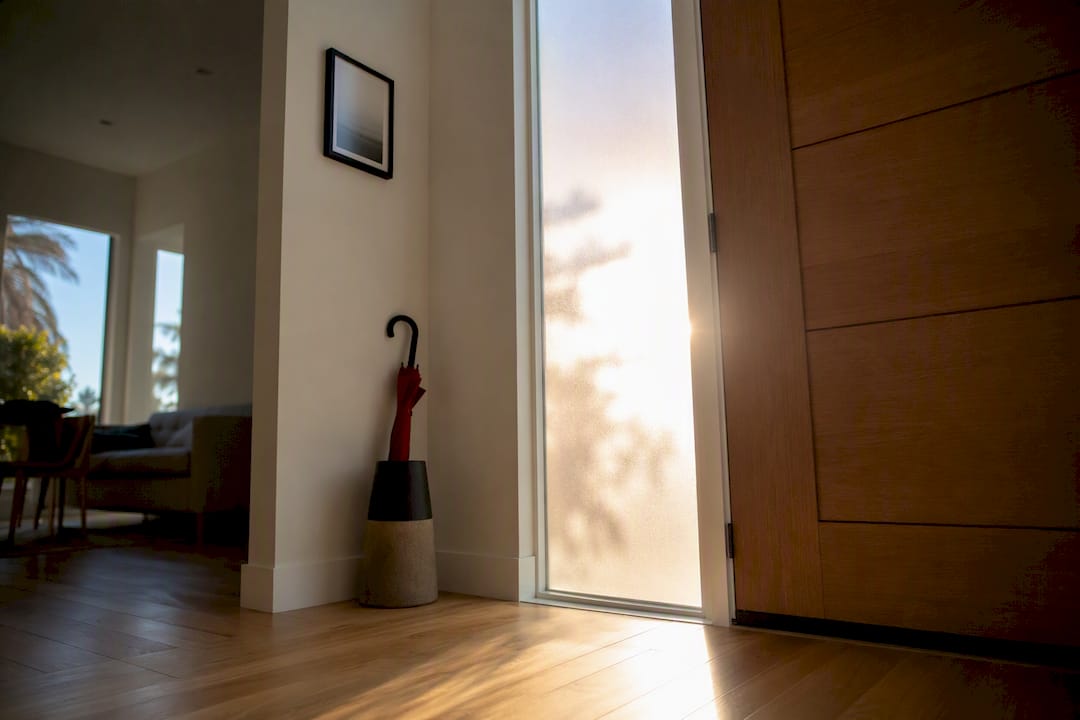
For most homeowners, frosted or semi-privacy striped sidelight privacy film gives reliable coverage without dimming the entryway. Even better: applying film only to the upper portion of the panel, about a third to two-fifths of its height, blocks a visitor’s direct sightline while leaving the rest of the glass clear. One-way reflective film works during the day but flips against you at night, once the lights go on inside, so treat it as a secondary option, not the default.
TL;DR:
- Frosted or striped films transmit up to 80–90% of natural light, with frosted blocking around 70–80%, making partial coverage a better balance of privacy and brightness.
- Proper measurement focuses solely on the glass dimension, and over- or under-sizing by just a quarter inch can affect installation quality and final appearance.
- Static-cling films are easier to remove and suited for renters, but they have shorter lifespans and may lift or bubble over time, unlike professionally installed adhesive films.
- One-way reflective films work during the day but lose privacy at night when interior lights are on, making them less reliable as the primary solution.
- Installing film on textured, Low-E, or intricately framed sidelights may require special considerations or professional expertise to ensure proper adhesion and performance.
Table of Contents
- What Types of Sidelight Privacy Film Work Best?
- How Do You Measure a Sidelight for Film?
- How Much Light Do Privacy Films Actually Block?
- DIY Static-Cling or Professional Installation?
- How Do You Apply Sidelight Film Yourself?
- How Long Does Sidelight Film Last, and How Do You Clean It?
- Does Sidelight Film Affect Insulation and UV Protection?
- Are There HOA or Legal Restrictions on Sidelight Film?
- Will Sidelight Film Work on My Glass and Frame Type?
- A Straight Answer on What Actually Works
- Get a Free Estimate for Residential Decorative Film
- Sources
- FAQ
What Types of Sidelight Privacy Film Work Best?
The right film depends on how much you want to see out versus how much light you’re willing to trade away. Sidelight window privacy products fall into a few main categories, and each one handles that trade differently.
- Frosted or etched film delivers full obscurity around the clock, day or night, and diffuses light rather than blocking it, transmitting roughly 70–80% of natural light.
- Semi-privacy striped film trades a bit of full coverage for daylight, transmitting closer to 85–90% while still breaking up the view enough that passersby can’t make out details inside.
- Decorative film, including stained-glass and leaded-glass patterns, is chosen mostly for style. Privacy varies by pattern, so check opacity before assuming a decorative design covers you fully.
- One-way reflective film mirrors the outside world back at visitors during daylight hours, but once your interior lights are brighter than the light outside, the effect reverses and people can see in.
- Security film costs more than standard privacy film but adds real value: it bonds to the glass and holds shards together on impact, which standard decorative or frosted films don’t do.
Pro Tip: If you like the look of decorative glass but need guaranteed privacy, pair a semi-transparent decorative pattern with an upper-zone frosted strip. You get the aesthetic and the coverage where it counts.
How Do You Measure a Sidelight for Film?
Sidelights are deceptively easy to measure wrong, mostly because people measure the frame instead of the glass. Only the glass matters for film sizing, and even panels that look identical from the porch often differ by a quarter inch or more once you get the tape measure out.
- Measure the exposed glass only, width and height, ignoring any wood or vinyl trim around the edges.
- Round down, not up. Film that’s slightly oversized is harder to trim cleanly than film cut a hair short.
- Measure both sidelights independently even if they look matched. Older homes especially settle unevenly over time.
- Check your measurement against common pre-sized product widths before ordering. Sidelights typically run 6 to 14 inches wide, and 7.75 inches and 11.75 inches are two of the most common pre-cut sizes on the market.
- If your glass falls outside standard widths, order from a wider roll and trim to fit rather than forcing an ill-fitting pre-cut panel.
Buying a pre-cut width that matches your glass saves material and cuts down on seam lines, which matter more on a narrow panel than they would on a picture window.
How Much Light Do Privacy Films Actually Block?
The numbers here matter more than most buying guides let on, because “privacy film” covers products with wildly different light behavior. Frosted film typically transmits 70–80% of natural light, scattering it into soft, even illumination rather than a direct beam.
By the numbers: Frosted sidelight film transmits 70–80% of light. Striped film transmits 85–90%. Professional-grade privacy films range from 20% to 85% opacity, with the higher end blocking nearly all direct visibility.
A useful real-world example: a 12 by 72 inch sidelight getting 300 to 600 lux of clear daylight will still deliver roughly 210 to 480 lux through standard frosted film, which is plenty for a comfortable, well-lit foyer.
- Low opacity (around 20%) reads almost like tinted glass; good for glare, weak for privacy.
- Mid-opacity (40–60%) is the sweet spot most homeowners land on for entryways.
- High opacity (80–85%) approaches full frosted coverage, best for street-facing panels with heavy foot traffic.
One-way reflective film behaves differently from all of these. It relies on the outside staying brighter than the inside, so it works during the day but loses privacy effectiveness after dark once your interior lamps switch on.
DIY Static-Cling or Professional Installation?
Static-cling film is the low-commitment option, and it’s popular for good reason. It’s removable without adhesive residue, which makes it a natural fit for renters or anyone testing out a style before committing. The tradeoff is a shorter service life and, on some budget products, edges that lift over time or bubbling that never fully works out no matter how careful the application.
Professional adhesive film solves both problems. It bonds directly to the glass for a cleaner, longer-lasting finish, and premium films block a very high percentage of UV rays compared to the more limited protection you get from a cling product. That UV blocking also protects flooring and furniture near the entryway from fading.
- Choose DIY when you’re renting, testing a look, or working with a tight budget.
- Choose professional installation when you want security film, need multiple panels to match perfectly, or want a warranty backing the work.
- Choose professional installation when UV protection and longevity matter more than upfront cost.
Professional window film installers have been working across Southern California homes since 2008, using premium 3M and LLumar materials and offering lifetime warranties, which is especially important on panels near a front door that take daily sun exposure.
How Do You Apply Sidelight Film Yourself?
Applying film to a narrow sidelight is more finicky than a full-size window simply because there’s less surface to work with and less room for error at the edges. Getting your tools together before you start makes the whole process faster.
You’ll need a spray bottle with a mild soap-and-water solution, a squeegee, a sharp utility knife, a lint-free cloth, and an accurate tape measure.
- Measure the glass and cut your film about half an inch oversized on each side.
- Clean the glass thoroughly, then clean it again. Dust and residue are the number one cause of bubbling.
- Spray the glass generously with the soap solution and apply the film wet, sliding it into position before it sticks.
- Squeegee from the center outward in overlapping strokes to push out water and air.
- Trim the excess with the utility knife, using a straightedge for a clean line.
For the partial-coverage method, measure down from the top of the panel to 30–40% of its total height, then apply film only to that upper section. That zone blocks the direct sightline a visitor gets standing at your door, while the lower two-thirds of the glass stay clear and keep daylight pouring in.
Pro Tip: If bubbles show up after the film dries, don’t panic and don’t repeat the whole install. Small bubbles near the edge usually work themselves out within a day as residual moisture escapes.
How Long Does Sidelight Film Last, and How Do You Clean It?
Cleaning is simple once you know the one rule that trips people up: wait. Adhesive film needs time to fully cure, often several weeks, before you clean it with anything beyond a light water rinse. After that, a soft cloth and a non-abrasive cleaner is all it takes.
- Avoid ammonia-based glass cleaners, which can degrade film adhesive over time.
- Static-cling film generally has a shorter useful life than adhesive film and is more prone to lifting at the edges after repeated handling.
- Watch for peeling corners, cloudy discoloration, or bubbles that won’t flatten. Any of those signals it’s time to replace the panel.
- Removing static-cling film is a simple peel with no residue, while adhesive film removal sometimes benefits from a heat gun and a professional’s steady hand to avoid scratching the glass.
Does Sidelight Film Affect Insulation and UV Protection?
Film adds a genuine, if modest, insulating benefit to a sidelight. A thin layer of film creates a small air gap and slows heat transfer through the glass, which helps in both directions: less heat escaping in winter, less heat radiating through in summer. It won’t replace a storm door or double-pane glass, but on single-pane sidelights, which are common in older homes, the difference is noticeable near the entryway.
UV protection is where film earns its keep most clearly. Standard glass blocks very little ultraviolet light on its own, which is why hardwood floors and rugs near a front door often fade faster than flooring elsewhere in the house. That protection compounds over years, not days, so the benefit shows up as flooring and trim that simply hold their color longer than an untreated sidelight would.
Frosted and striped films still carry some of this UV benefit, though it varies by product and thickness, so check the specification sheet rather than assuming every frosted film performs the same.
Are There HOA or Legal Restrictions on Sidelight Film?
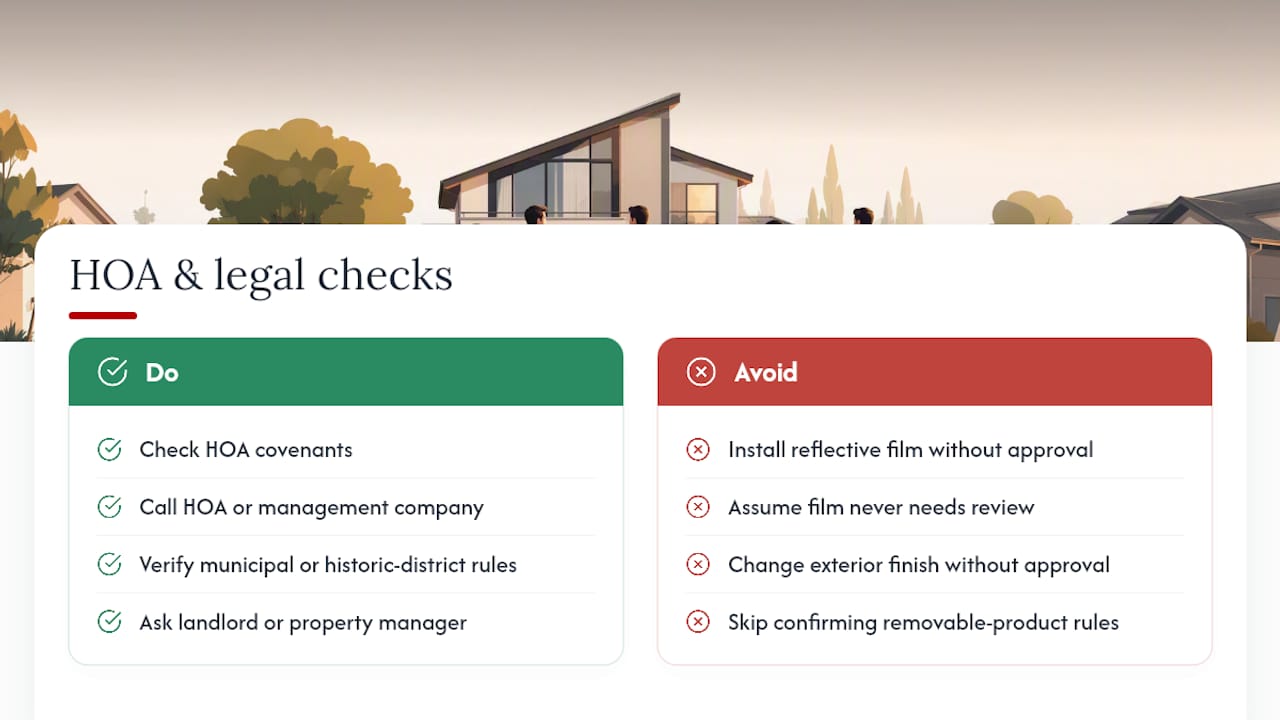
Exterior-facing window modifications sit in a gray area for a lot of homeowners, particularly anyone in a community governed by a homeowners association. Sidelight film applied to the interior surface of the glass, which is how most residential privacy film is installed, generally falls outside HOA architectural review because it doesn’t change the exterior appearance of the home. That said, HOA rules vary enormously from one community to the next, and some associations do restrict reflective or mirrored film specifically because of how it looks from the street.
Reflective one-way film is the category most likely to draw scrutiny, since a mirrored sidelight can visibly change a home’s exterior character in a way frosted or striped film doesn’t. Before installing anything with a reflective finish, check your HOA’s covenants or call the management company directly. It’s a five-minute phone call that avoids a much longer dispute later.
Municipal rules rarely address residential window film directly, but landlords and historic-district homeowners face their own layer of restrictions worth checking before any exterior glass modification. Renters in particular should confirm with a property manager that a removable static-cling product is acceptable, even though it typically requires no adhesive and leaves no permanent trace.
Will Sidelight Film Work on My Glass and Frame Type?
Most sidelight film applies to standard single-pane and dual-pane glass without any special preparation beyond a thorough cleaning. Where it gets more complicated is with textured, tempered, or Low-E coated glass, all of which are common in newer construction sidelights.
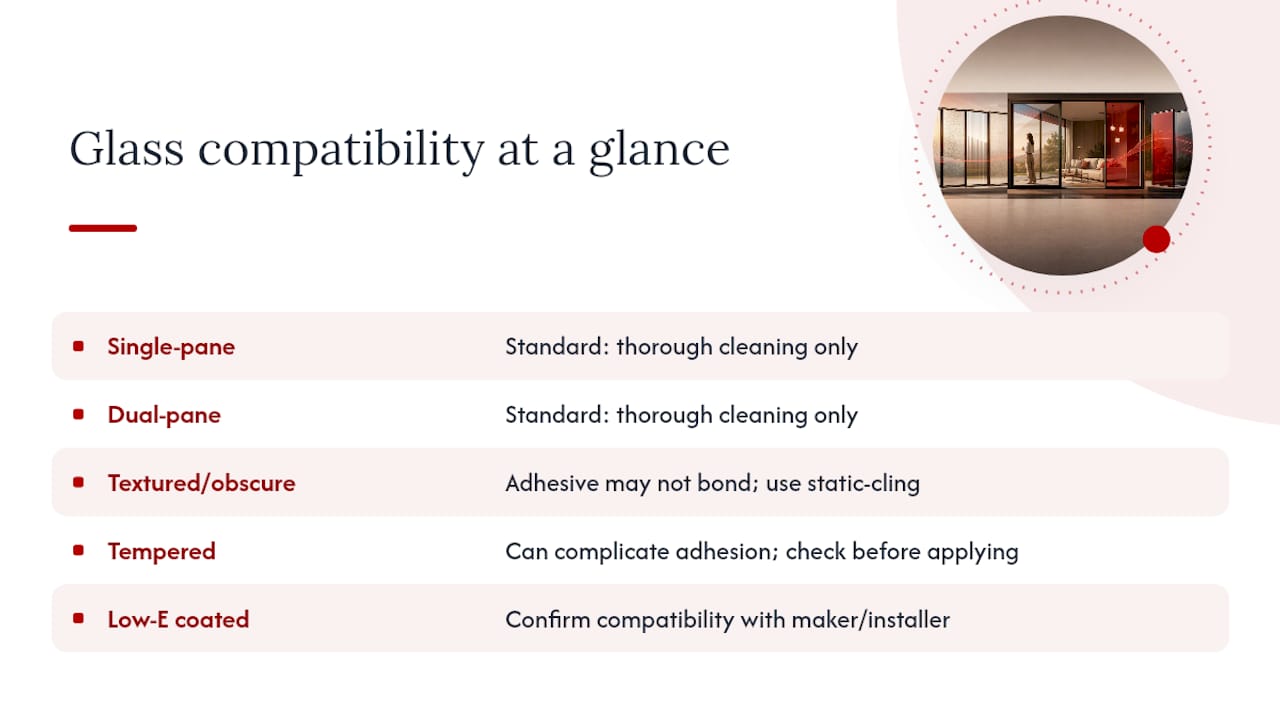
Textured or obscure glass, the kind with a wavy or pebbled surface built into the pane itself, doesn’t hold film smoothly since the adhesive can’t make consistent contact across an uneven surface. In those cases, a lighter static-cling product sometimes performs better than a full adhesive film, since it doesn’t rely on a perfect bond.
Low-E coated glass, common in energy-efficient windows, needs a quick check before installation. Certain films can interact with the coating and cause heat buildup between the layers, so it’s worth confirming compatibility with the film manufacturer or a professional installer before applying anything to coated glass.
Frame material rarely affects the film itself since film adheres to the glass, not the frame, but vinyl and aluminum frames with narrow reveals leave less room for error when trimming edges. A tight frame reveal means precise cutting matters more, which is one more reason a pre-sized product cut to a known width like 7.75 or 11.75 inches saves headaches on narrow panels. If your entry door has glass detailing beyond a simple sidelight, like a full glass-paneled interior door, matching the film treatment across both surfaces keeps the whole entryway looking intentional rather than patched together.
A Straight Answer on What Actually Works
Most guides oversell full-frost coverage as the automatic answer, and it’s not. Full frost solves privacy completely but turns a bright entryway into a dim one, and that trade isn’t worth it on a sidelight that’s already narrow and light-starved to begin with. The upper-zone partial coverage approach gets ignored constantly, probably because it takes a bit more measuring precision than slapping film across the whole panel, but it’s the better solution for the vast majority of front doors.
The other thing homeowners underestimate is how much the DIY versus professional decision comes down to how long they plan to stay in the house. A cling film bought for $20 makes sense for a two-year rental. It makes far less sense for a forever home where you’ll want the UV protection and edge durability that only a bonded, professionally installed film delivers. Professional window film installers across Southern California have seen both outcomes since 2008, working with 3M and LLumar materials that back that logic with real product performance. Get the coverage strategy right first, then decide how permanent you want the solution to be.
— Jake
Get a Free Estimate for Residential Decorative Film
Professional window film installers bring the pro-installation advantage this article just covered directly to your front door, often with certifications and warranties on the work and materials from brands like 3M and LLumar behind every panel. Instead of guessing at partial-coverage measurements or fighting bubbles on a narrow sidelight yourself, a certified crew can handle the sizing, the cut, and the clean edge finish in one visit.

Twtwindowfilm’s team installs frosted and decorative film sized specifically for your sidelights, matches multiple panels so they look uniform from the street, and provides a free on-site estimate before any work begins. Homeowners who want the added UV and impact benefits can also ask about residential security film alongside the decorative install. Visit the residential services page to schedule a free estimate and get a written quote for your entryway.
Sources
- International Window Film Association (sizing, light transmission, opacity, UV protection)
- Blindshades
FAQ
How Do You Cover Sidelights for Privacy Without Losing Light?
That partial-coverage approach preserves most of the direct daylight coming through the lower glass.
What Is the Best Sidelight Window Film for Most Homes?
Semi-privacy striped film is usually the best balance, since it transmits about 85–90% of natural light while still breaking up the view. Frosted film is the better pick if full, consistent privacy day and night matters more than maximizing brightness.
What Window Privacy Film Lets in the Most Light?
Frosted film comes in lower, around 70–80%, because it diffuses rather than partially clears light through open stripes.
What Are the Disadvantages of Window Privacy Film?
Static-cling products can bubble, lift at the edges, and wear out faster than adhesive film. One-way reflective film loses its privacy effect at night once interior lights are on, and poor-quality DIY installs sometimes leave visible seams or trapped air that a professional install avoids.
Does Twtwindowfilm Install Sidelight Privacy Film?
Yes. Twtwindowfilm installs residential decorative and frosted film on sidelights and entry doors throughout Southern California, using 3M and LLumar materials backed by a lifetime warranty. Current pricing is available through a free on-site estimate.