

The Fastest Ways to Reduce Window Heat This Summer
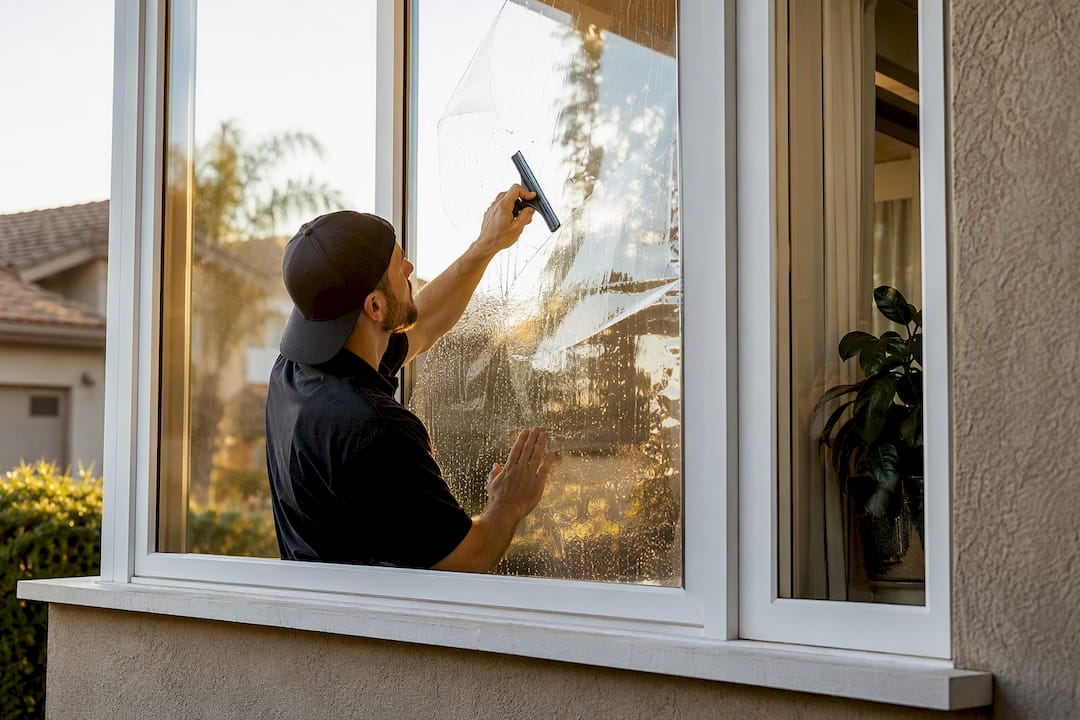
The most reliable way to reduce window heat is to block sunlight before it reaches the glass, add professional-grade window film where exterior shading isn’t practical, seal air leaks around every frame, and treat interior curtains and shades as a backup layer, not your main defense. That order matters. Each layer amplifies the next.
Here’s what each layer actually delivers:
- Exterior shading (awnings, solar screens, trees): blocks 65–77% of solar heat gain depending on exposure
- Professional window film: reduces solar heat gain by up to 78% while rejecting most UV
- Cellular shades (sealed at the edges): 40–60% reduction
- Blackout curtains: 24–33% reduction, the weakest standalone option
Start today with what costs nothing: close blinds on the sun-facing side by mid-morning, check for gaps around frames, and get a professional estimate for film on your worst-offending windows. The rest of this guide breaks down why that order works and how to execute each step.
Key Takeaways
Reducing window heat works best as a layered system: block sunlight before it hits the glass, reflect what gets through with professional film, seal every gap, then finish with interior treatments.
| Point | Details |
|---|---|
| Exterior shading comes first | Awnings and solar screens block 65–77% of heat before it ever reaches your glass. |
| Ceramic film balances heat and light | Spectrally selective and ceramic films reduce heat up to 78% without darkening windows. |
| Sealing multiplies every other fix | Weatherstripping and caulking are the cheapest steps and prevent leaks that undercut film or shading. |
| Interior treatments are a backup layer | Cellular shades (40–60%) outperform blackout curtains (24–33%) but shouldn’t be your only defense. |
| Orientation drives priority | West and south-facing windows need attention first; north-facing glass rarely does. |
| Professional installation protects the investment | Twtwindowfilm’s lifetime-warrantied installs of 3M and LLumar film avoid the bubbling and peeling common with DIY kits. |
Table of Contents
- How Windows Let Heat Into Your Home
- What Exterior Shading Options Work Best?
- Is Professional Window Film Worth the Cost?
- Do Interior Treatments Actually Reduce Heat?
- Sealing Gaps and Emergency Heat Fixes
- When Does It Make Sense to Replace Windows?
- Dyed vs. Metalized vs. Ceramic Film: Which One Fits Your Windows?
- Why Window Orientation Changes Your Heat Problem
- Exterior vs. Interior Treatments: Weighing the Tradeoffs
- How Long Do Heat-Reducing Window Solutions Actually Last?
- A Practitioner’s Take on Getting This Right
- Get a Professional Estimate for Lasting Heat Reduction
- Sources
How Windows Let Heat Into Your Home
Sunlight carries both visible light and infrared radiation, and it’s the infrared component that turns your living room into a greenhouse. Once that radiation passes through glass, it converts to heat and gets trapped inside. Curtains and interior shades absorb that trapped heat and then radiate a portion of it right back into the room, which is why interior-only fixes plateau at modest results.
Glass also conducts heat directly, and gaps around frames let warm air convect straight into your house regardless of what’s covering the window. That’s why sealing isn’t a footnote. It’s a multiplier. A well-sealed window makes every other measure work better, while an unsealed one leaks value from even the best film or shading job.
This is the logic behind the tiered approach: stop radiation before it hits glass, reflect what gets through, then manage the leftover heat with interior treatments and a tight seal.
What Exterior Shading Options Work Best?
If you can only do one thing this year, do this. Exterior solutions intercept heat before it ever touches your glass, which puts them ahead of every interior product on the market.
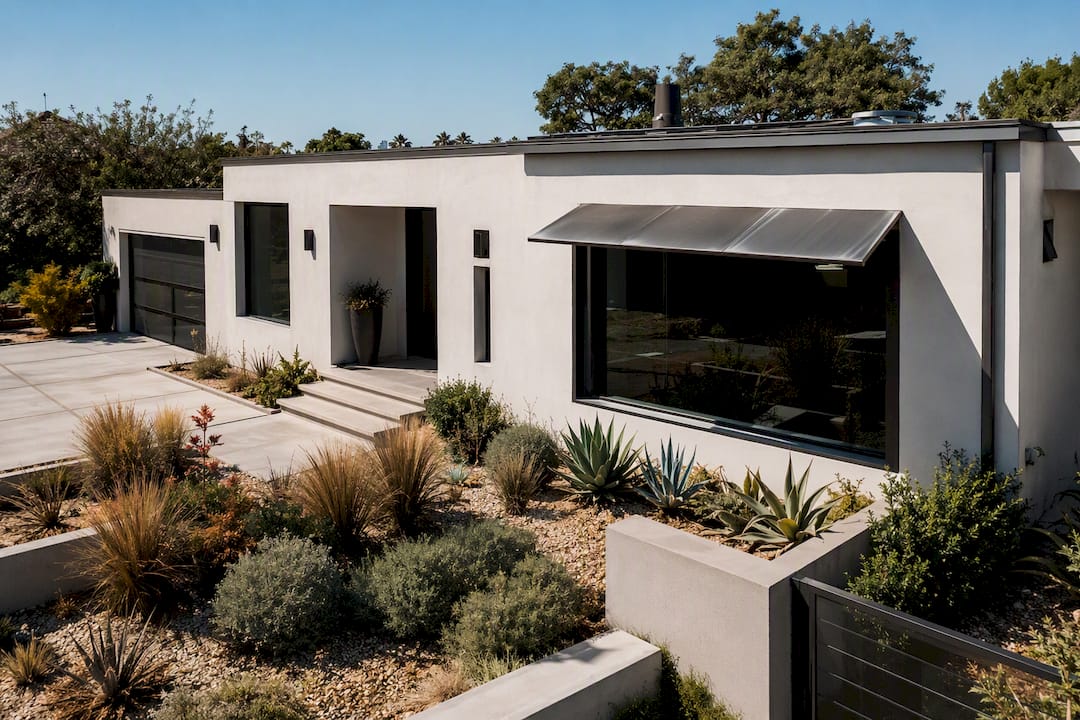
Awnings are the workhorse here. On south-facing windows they cut solar heat gain by up to 65%, and on west-facing windows (usually your hottest exposure in the late afternoon) that figure climbs to 77%. Exterior roll-down solar screens perform similarly and have the advantage of retracting when you want the light back. Fabric options like Phifer SunScreen can absorb and dissipate up to 70% of incoming heat and glare before it ever reaches the pane.
Trees and pergolas play a longer game. A mature shade tree on the west side of a house can outperform almost anything else on this list, but it takes years to establish and isn’t an option for every lot size or HOA. Pergolas with retractable canopies give you a middle ground: less permanent than a tree, less mechanical than a roll-down screen.
The tradeoffs are real. Awnings and screens change your home’s exterior look, some require permits depending on your city, and retractable versions need seasonal adjustment (you want them extended in summer, retracted in winter to let heat in). West and south exposures see the biggest payoff; north-facing windows rarely need this investment at all.
Realistic range: exterior shading alone typically knocks out 60–80% of the solar heat gain that would otherwise pass through unshaded glass, according to combined method rankings.
Is Professional Window Film Worth the Cost?
For windows where an awning or exterior screen isn’t feasible, whether because of architecture, HOA rules, or budget, professional window film is the closest thing to a universal answer.
Not all film works the same way. Dyed film is the cheapest option and mainly reduces glare by darkening the glass. It doesn’t reject much infrared, so it’s a poor pick if heat is your primary concern. Reflective (metalized) film blocks more heat but gives windows a mirrored look that many homeowners find too aggressive for a residential facade. Ceramic and spectrally selective films solve both problems at once: they target the infrared wavelengths responsible for most heat gain using nano-ceramic particles, without darkening the glass or killing your view.
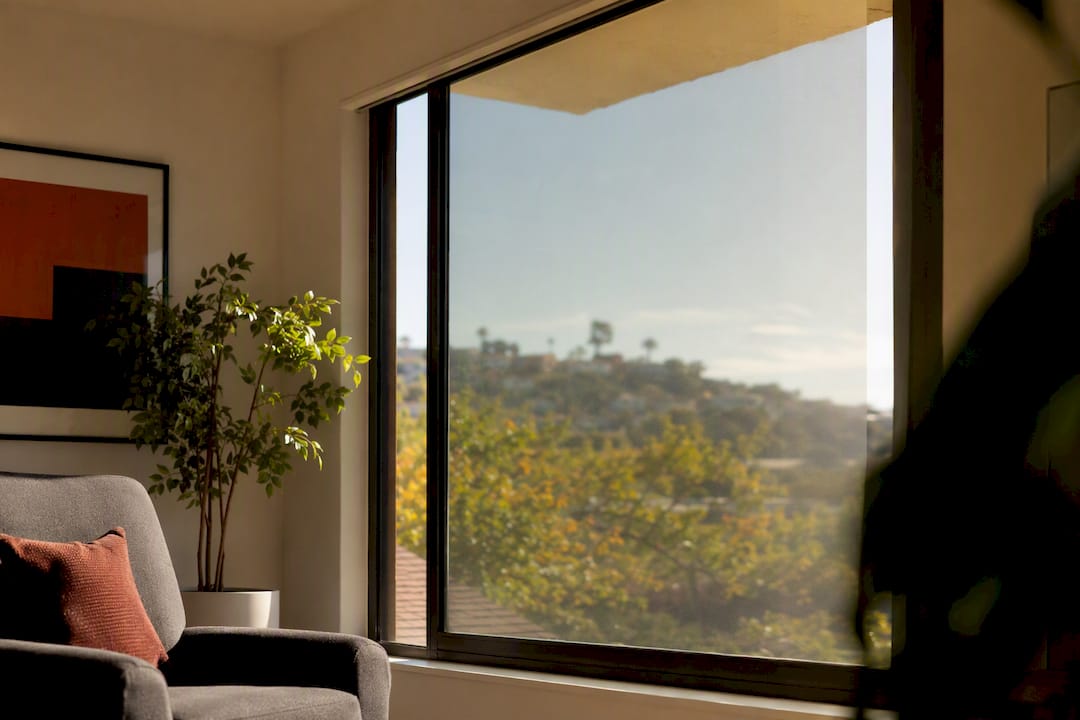
That distinction is why ceramic and spectrally selective options dominate residential recommendations. You keep natural light and a clear view while the film does the heavy lifting on heat.
The numbers back it up. High-performance films can block up to 78% of solar heat gain and reject up to 99% of UV rays, which also protects flooring and furniture from fading. That level of infrared rejection isn’t achievable with a peel-and-stick kit from a hardware store.
Installation quality changes the outcome. Professional installers control for microscopic dust and debris during application and use proper edge-seam and squeegee technique, while DIY jobs are prone to bubbling, delamination, and premature peeling that quietly erode performance within a year or two. A lifetime warranty on installation only means something if the install was done right the first time.
Pro Tip: Ask any installer which film is spectrally selective versus simply tinted. A lot of budget film is marketed as “heat reduction” when it’s really just dyed glare control. The wavelength it rejects matters more than how dark it looks.
Maintenance is minimal: clean with a soft cloth and non-ammonia glass cleaner, and quality film should hold up for well over a decade. Energy savings vary by climate and window count, but homeowners in hot exposures often see the film pay for itself over several years of reduced cooling costs. Explore residential solar control film options if you’re weighing this for your own house.
Do Interior Treatments Actually Reduce Heat?
Interior treatments are your backstop, not your first line of defense, but they’re worth optimizing if you rent, can’t modify the exterior, or want an added layer on top of film.
- Blackout curtains reduce heat gain by roughly 24–33%, the weakest of the interior options, but the cheapest and easiest to install.
- Cellular (honeycomb) shades perform far better, cutting heat gain by 40–60% when mounted close to the glass with side seals intact.
- Blinds land in the middle at roughly 30–45%, depending on slat material and how tightly they’re closed.
Small installation choices swing these numbers a lot. Mounting shades as close to the glass as possible, adding side channels or magnetic seals to stop air from slipping around the edges, and choosing double-cell over single-cell honeycomb construction all meaningfully improve real-world performance. A reflective backing on curtains adds another bump.
Interior treatments make the most sense for renters, for windows with no exterior access, or as a supplement layered on top of film for rooms that run especially hot. On their own, they’re rarely enough for a west-facing bedroom in July.
Sealing Gaps and Emergency Heat Fixes
Weatherstripping and caulking around your window frames are the most cost-effective steps on this entire list, and they’re the ones most homeowners skip. Air leaking around an unsealed frame undercuts whatever film or shading you’ve installed, since convective heat transfer doesn’t care how good your window treatment is.
- Run a hand around the frame on a hot day and feel for warm air moving through gaps.
- Apply weatherstripping to movable parts (sashes, the bottom of sliding windows).
- Caulk any fixed seams between the frame and the wall.
- Recheck after a season, since caulk and weatherstripping degrade with weather exposure.
For a genuine heat emergency, when the AC is down or a heat wave hits before you’ve made permanent upgrades, a few short-term fixes help. Bubble wrap and taped cardboard offer moderate relief and are less of an eyesore. Skip damp sheets over windows; they add humidity indoors without meaningfully blocking radiation.
Pro Tip: If you’re sealing gaps yourself, do it before you invest in film or exterior shading. A drafty frame will make even the best window film underperform its rated numbers.
When Does It Make Sense to Replace Windows?
Low-E coatings and double or triple-pane glazing deliver real, lasting heat reduction, but replacement is a much bigger investment than film or shading, often running into the thousands of dollars per window depending on size and glazing type.
Replacement earns its cost when your windows are single-pane, decades old, physically damaged, or when you’re seeing persistently high cooling bills that sealing and film haven’t fixed. If you plan to stay in the home long term, the upfront cost amortizes better.
If your windows are structurally sound and just hot, retrofit first: seal, shade, and film. Save replacement for when the glass or frame itself is the actual problem, not just the lack of a heat barrier on top of it.
Dyed vs. Metalized vs. Ceramic Film: Which One Fits Your Windows?
Choosing a film isn’t a one-size decision, since each type solves a different problem and fits a different budget.
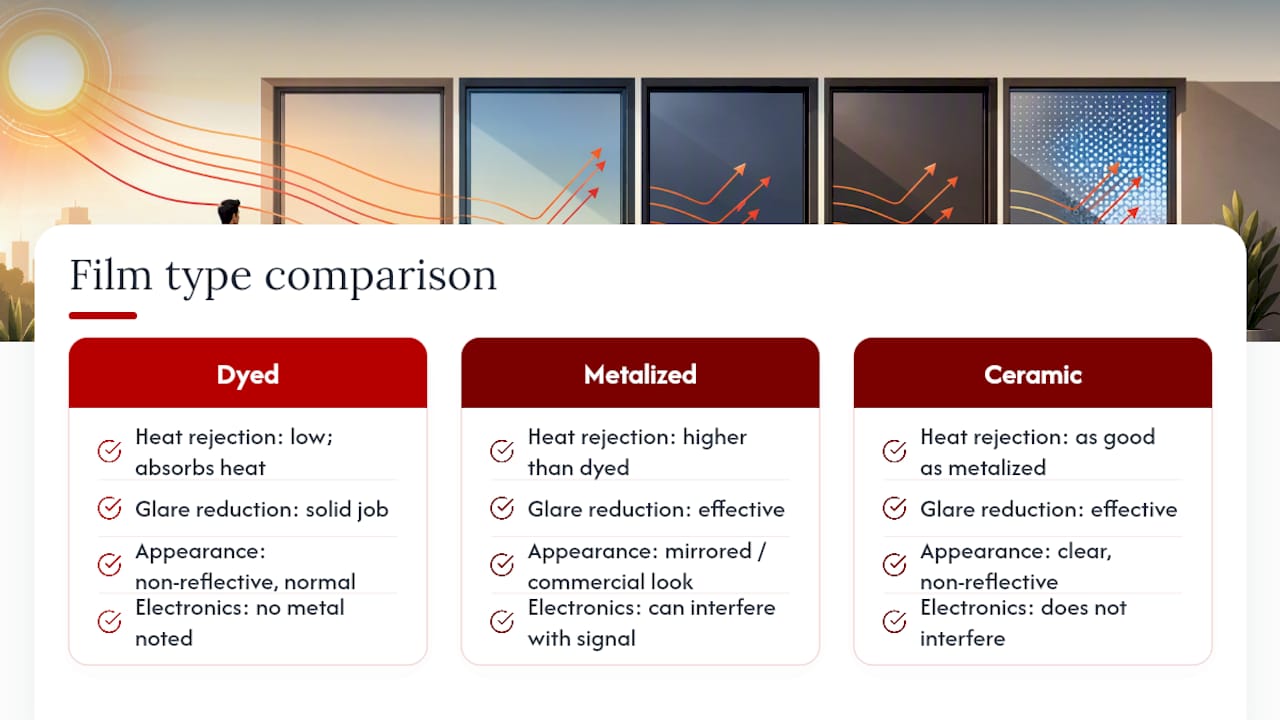
Dyed film works by absorbing solar energy into a dye layer sandwiched in the film. It’s the most affordable option and does a solid job cutting glare, but it absorbs heat rather than reflecting or rejecting it, meaning that absorbed heat can still radiate into the room over time. It’s best suited for glare control on a tight budget, not for a west-facing living room that bakes every afternoon.
Metalized (reflective) film uses a thin metallic layer to bounce solar energy away from the glass. It rejects more heat than dyed film and holds up well over years of sun exposure, but the tradeoff is appearance: the mirrored look reads as commercial to a lot of homeowners, and it can interfere with cell signal or Wi-Fi in some cases due to the metal content.
Ceramic film uses non-conductive, non-metallic ceramic particles engineered to target infrared wavelengths specifically. It rejects heat at a level competitive with metalized film, doesn’t interfere with electronics, resists fading, and keeps a clear, non-reflective appearance. It costs more upfront than dyed film, but for anyone prioritizing both heat performance and curb appeal, it’s the film category worth building your decision around.
For most residential applications where the homeowner wants heat control without turning windows into mirrors, ceramic or spectrally selective film is the practical default. Dyed film has its place for low-cost glare fixes; metalized film suits situations where appearance matters less than raw reflectivity.
Why Window Orientation Changes Your Heat Problem
Not every window in your house is fighting the same battle, and treating them identically wastes money.
West-facing windows take the worst of it. South-facing windows get more consistent, higher-angle sun through the middle of the day, which is actually easier to manage with a properly sized overhang or awning since the sun sits higher in the sky.
East-facing windows deal with morning sun, generally a smaller cooling burden since temperatures haven’t peaked yet. North-facing windows in the Northern Hemisphere receive the least direct solar radiation year round and often need little more than basic sealing.
Glass type matters just as much as direction. Older single-pane windows conduct heat far more readily than modern double-pane units, and windows without any Low-E coating let more infrared through regardless of orientation. A single-pane west-facing window is close to a worst-case scenario for heat gain, and it’s exactly the kind of window that benefits most from stacking film, shading, and sealing together rather than relying on just one fix.
Walk your house at different times of day and note which rooms heat up fastest. That tells you where to spend your budget first.
Exterior vs. Interior Treatments: Weighing the Tradeoffs
Exterior treatments win on raw performance because they stop heat before it becomes a problem inside your walls. Awnings, screens, and film (which sits on the exterior-facing surface of the glass) intercept energy at the source. Interior treatments manage heat after it’s already inside, which is a fundamentally weaker position, since some of that trapped energy still radiates into the room even with a good curtain or shade in place.
But exterior solutions come with real friction. Awnings and roll-down screens change how your house looks, may need HOA approval, and cost more to install than a set of cellular shades from a home store. They’re also somewhat weather-exposed and need occasional maintenance or replacement.
Interior treatments win on flexibility and reversibility. Renters can install and remove them without altering the property. Homeowners can swap them seasonally, use them for privacy and heat control at once, and combine them with film for a layered effect that closes the gap with exterior-only performance. The Cornell Cooperative Extension’s recommended sequence makes this explicit: inspect exposure, seal leaks, add exterior shading where feasible, apply film to high-exposure glass, then layer interior shades on top for additional control.
The realistic answer for most homes isn’t exterior or interior. It’s exterior where you can, film where you can’t, interior treatments everywhere as the final layer.
How Long Do Heat-Reducing Window Solutions Actually Last?
Durability varies enormously across these options, and it affects the real cost of each one over a decade of ownership.
Quality window film, properly installed, typically holds up for well over ten years with minimal degradation, provided it’s cleaned with non-ammonia products and the installation was done by someone who controlled for dust and bubbling during application. Poorly installed film, especially DIY kits, tends to bubble, discolor, or peel at the edges within a few years, which erases most of the performance advantage you paid for.
Exterior awnings and solar screens face direct weather exposure, so expect fabric replacement or recoating somewhere in the 10 to 15 year range depending on climate and UV exposure. Retractable mechanisms need occasional lubrication and hardware checks.
Cellular shades and blinds inside the home last the longest structurally, often 15 to 20 years, since they’re shielded from direct weather, but their fabric or cord mechanisms can wear out sooner with heavy daily use. Weatherstripping is the shortest-lived component on this list. Foam and rubber seals compress and crack within a few years and need regular inspection and replacement to keep doing their job.
The pattern across all of these: professional installation and periodic upkeep protect your investment far more than the base material choice does.
A Practitioner’s Take on Getting This Right
Most homeowners fix the symptom, not the sequence. They buy blackout curtains, wonder why the room still feels like an oven, and never check whether air is leaking around the frame the whole time. Work the layers in order: exterior shading first, film on what’s left exposed, seal every gap you find, and let interior treatments finish the job. If a room stays hot after sealing and shading, that’s your signal to call a professional about film rather than buying a third set of curtains.
Quick checklist:
- Note which windows face west and south
- Feel for drafts around every frame
- Seal what you find with weatherstripping or caulk
- Try a low-cost fix (screens, foil) on the worst offender
- Get film quotes for high-exposure glass
- Book a professional estimate before peak summer
— Jake
Get a Professional Estimate for Lasting Heat Reduction
Sealing gaps and hanging curtains only gets a hot room so far. When the goal is durable, meaningful heat reduction without covering your windows in reflective mirror film, professional installation is what actually closes the gap between a rated performance number and what you feel in the room.

Twtwindowfilm has been installing spectrally selective and ceramic film across Southern California homes and businesses since 2008, using premium 3M and LLumar materials backed by a lifetime warranty on the install itself, not just the product. That warranty matters because most film failures trace back to installation error, not the material. Correct film selection for your specific exposure, dust-free application, and properly sealed edges are what separate a film that lasts fifteen years from one that bubbles in eighteen months. Homeowners across Orange County and Los Angeles County can request a free on-site estimate to find out which film fits their windows, their budget, and how much sun each room actually takes on. Reach out to get your worst-exposed windows assessed before the next heat wave hits.
Sources
- Window treatments | U.S. Department of Energy
- Home Window Films for Temperature Control | 3M United States
- Energy-saving window treatments | Cornell Cooperative Extension Monroe County
- How to Block Heat From Windows in Summer: Every Method Ranked by Effectiveness | Evapolar blog