

Office Privacy Film: Types, Costs, and How to Choose
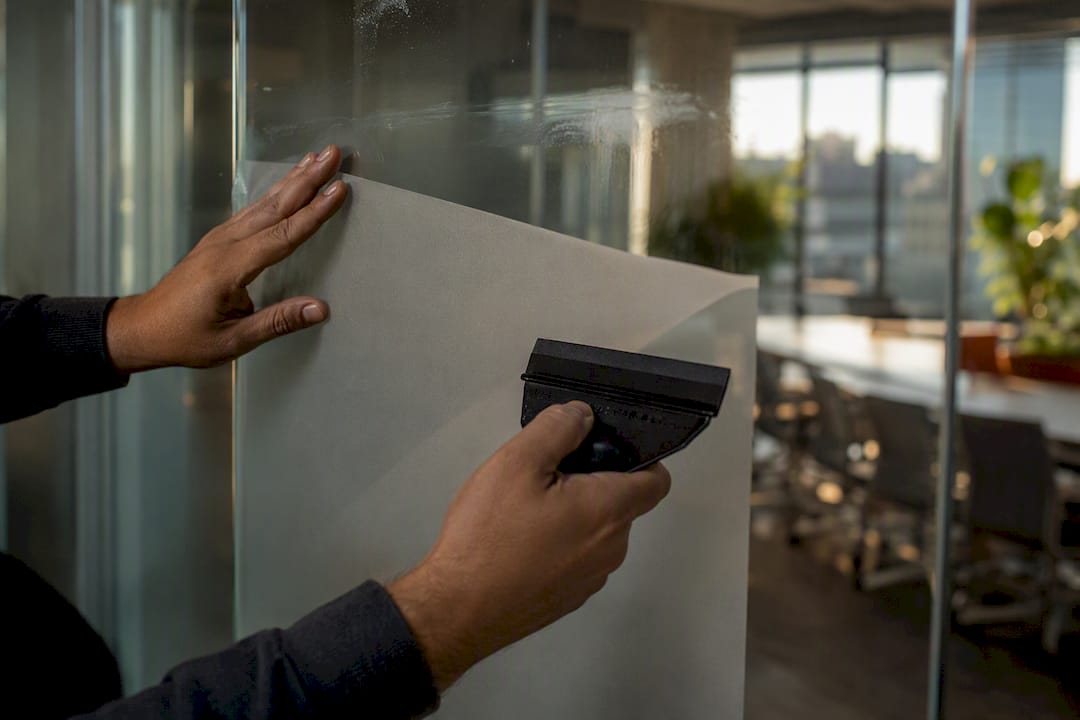
For interior glass, frosted or decorative privacy film solves the problem without blocking daylight. For exterior windows, pair privacy film with a solar-rated product so heat and UV get handled at the same time. On a commercial project, hire a certified installer rather than attempting a DIY job. The material cost is rarely the issue. Poor installation is.
Before signing off on any vendor or product, do this:
- Request free sample swatches and view them in your actual office lighting
- Confirm whether you need interior only or an exterior-rated film
- Ask for a written warranty covering both material and installation
- Schedule a site visit for an accurate, glass-specific estimate
Key Takeaways
Office privacy film succeeds or fails based on installer skill and warranty terms far more than on which brand of film gets specified.
| Point | Details |
|---|---|
| Match film to room priority | Rank confidentiality, aesthetics, and light transmission, then pick the lightest film that still meets the top need. |
| Verify interior vs. exterior rating | Confirm the film is rated for its actual glass location before ordering to avoid early failure. |
| Get warranty terms in writing | Request both a manufacturer material warranty and an installer workmanship guarantee. |
| Order samples before committing | View swatches against your own glass under your office’s actual lighting at different times of day. |
| Work with a certified local installer | Twtwindowfilm has installed 3M and LLumar film across Orange County and LA since 2008 with a lifetime warranty and free on-site estimates. |
Table of Contents
- Types of Office Privacy Film and How Each Performs
- Where to Place Privacy Film for the Best Results
- What Should You Check Before Choosing a Privacy Film?
- How Much Does Office Privacy Film Cost to Install?
- How Long Does Privacy Film Last and What Maintenance Does It Need?
- Why Work With a Locally Established Window Film Company?
- How Do 3M and LLumar Compare on Office Privacy Film?
- Matching Film Type to Your Office’s Actual Privacy Needs
- What to Ask Before Hiring a Privacy Film Installer
- How Do You Get Samples Before Committing to a Project?
- The Real Decision Point Most Guides Skip
- Ready to Move From Research to a Site Visit?
- Sources
Types of Office Privacy Film and How Each Performs
Frosted or etched film is the default choice for most offices. It diffuses light rather than blocking it, so conference rooms and glass partitions stay bright while sightlines disappear. Light transmission stays high even though the view through the glass does not.
Decorative and patterned films do double duty. Beyond privacy, they carry logos and branding elements directly onto the glass, which is why reception areas and storefronts use them so often. Pricing shifts with how much customization you want.
Other categories worth knowing:
- Gradient or band films: privacy at eye level only, glass stays clear above and below
- Blackout films: total visual block, suited to vaults, server closets, or interview rooms
- Mirror/reflective films: one-way privacy that depends on which side has more light
Pro Tip: Mirror film only works one way when the exterior is brighter than the interior. Once the sun goes down and your office lights are on, that effect reverses and passersby can see straight in.
Where to Place Privacy Film for the Best Results
Placement decisions come down to how much confidentiality a given room actually needs.
- Conference rooms: full frosting for legal or HR use, partial banding for standard meeting spaces.
- Glass partitions and workstations: a privacy band or frosted lower panel keeps desks screened without darkening the whole wall, an approach that balances an open floor plan with real visual privacy.
- Doors and sidelights: a frosted band or etched logo at eye level, common in reception zones and near glass-paneled interior doors.
- Exterior-facing glass: pair privacy film with a solar control layer when glare or heat gain is also a problem.
- Server rooms and government offices: prioritize security-rated or higher-durability film over decorative options.
What Should You Check Before Choosing a Privacy Film?
Start with light transmission numbers, not just the sample photo on a website. A film rated for high transmission will still block direct sightlines while keeping a conference room from feeling like a sealed box. Ask the vendor for the specific percentage, then hold the swatch against your own windows at different times of day.
Confirm interior versus exterior rating early. Many privacy films are engineered for interior use only, and applying one outdoors will shorten its life dramatically. Scratch resistance matters too, especially on doors and low partitions that get touched constantly.
Run through this list with any vendor before signing a quote:
- Light transmission percentage and in-situ sample viewing
- Interior vs. exterior rating, plus scratch and abrasion resistance
- Solar and UV performance data if the glass faces direct sun
- Customization options, lead time, and minimum order size
- Written warranty terms covering both material and workmanship
- At least one reference installation you can see in person or in photos
Sample books and swatches are standard across the industry, precisely so buyers can judge appearance under their own lighting instead of guessing from a catalog photo. Skipping that step is the single most common reason offices end up disappointed with a film they picked online.
How Much Does Office Privacy Film Cost to Install?
Pricing typically follows a per-square-foot model, with separate line items for sample requests, custom graphics, and any minimum order the vendor enforces. Larger conference room walls and multi-door partition runs cost more not just because of square footage, but because of the cutting precision custom patterns demand.
- Sample request: usually free, sometimes with a small deposit refunded on order.
- Measurement and site visit: a technician measures each pane and notes obstructions like hardware or seals.
- Production: custom graphics and patterns take longer to cut than standard frosted sheets.
- Installation: most office film jobs finish within a single day for standard rooms, since the film goes on in place with no need to pull the glass. Larger buildings get staged across several days.
- Final walkthrough: check edges, bubbles, and alignment before signing off.
Professional installation avoids the two most expensive mistakes in a DIY attempt: trapped air bubbles that never fully cure out, and edge lifting that voids any material warranty. When you request your on-site estimate, have your floor plan and glass dimensions ready. It speeds up the quote and gets you a firmer number on the first visit instead of a rough range.
How Long Does Privacy Film Last and What Maintenance Does It Need?
Quality interior film commonly lasts 10 to 15 years or longer when installed correctly, and exterior-rated products vary more depending on sun exposure and climate. The installation itself, not just the film grade, drives most of that lifespan. Poor substrate prep or a rushed application is the leading cause of early failure, well before the film itself wears out.
Cleaning is simple if you stick to the basics:
- Use a soft cloth and mild, ammonia-free detergent
- Avoid abrasive pads or scrapers near the edges
- Wipe with the grain of any textured pattern, not against it
Ask for two separate warranties: one from the film manufacturer covering the material itself, and one from the installer covering workmanship. Bubbling, peeling edges, or visible discoloration are the clearest signs it’s time to call for a repair or replacement quote.
Why Work With a Locally Established Window Film Company?
Twtwindowfilm has operated in Southern California since 2008, specializing in commercial and residential film installation backed by a lifetime warranty. That local track record matters when you’re comparing quotes: an installer who has handled hundreds of office glass jobs in your climate knows how local sun angles and HVAC humidity affect adhesion.
- Locally owned, operating since 2008, with a lifetime warranty on installations
- Partners directly with 3M and LLumar for premium film stock
- Specializes in office privacy and frosted glass graphics, data center film, and combined solar and privacy film for exterior glass
- Provides free on-site estimates and sample review before any commitment
How Do 3M and LLumar Compare on Office Privacy Film?
Most credible office privacy film comes down to two manufacturer names: 3M and LLumar. Both produce matte, frosted, and mirror-style privacy films sold through certified installer networks rather than direct retail, which keeps quality control tighter than the generic film sold on general marketplace sites.
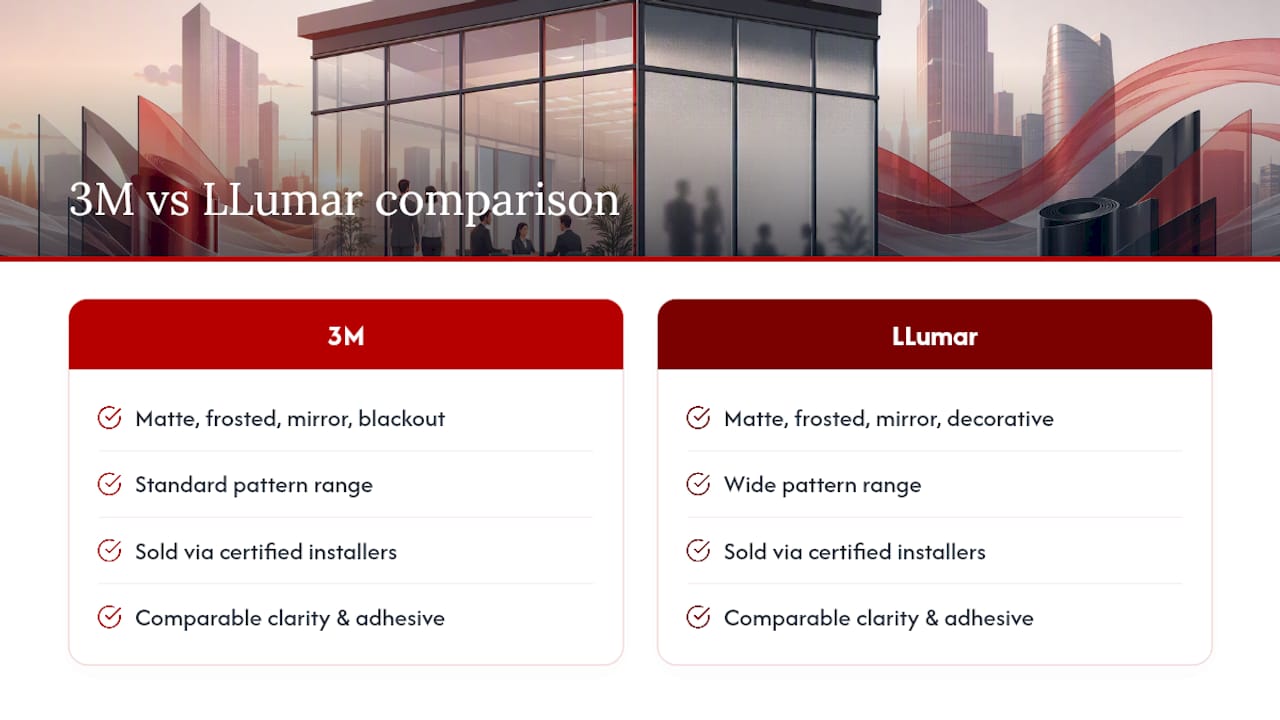
3M’s privacy film lineup includes matte, blackout, and mirror options explicitly marketed as a lower-cost alternative to replacing glass entirely, whether that’s swapping a clear office partition for etched glass or adding security-rated film to a storefront. 3M also publishes clear guidance on interior-only use for certain product lines, which is useful when a vendor tries to sell you an interior film for an exterior application.
LLumar’s decorative and privacy lines compete closely on clarity, adhesive quality, and pattern range, and the practical difference between the two brands often comes down less to the base film and more to who’s installing it. A precisely cut, well-sealed LLumar install will outperform a sloppy 3M job every time, and vice versa.
That’s the real takeaway for facilities managers: brand name gets you into the right performance tier, but installer skill determines whether you actually get 10 to 15 years out of the product or start seeing edge lift within eighteen months. Ask any vendor which brand they’re certified to install, not just which brand they sell, since certification usually comes with manufacturer-backed warranty support that a reseller relationship doesn’t.
Matching Film Type to Your Office’s Actual Privacy Needs
Degree of privacy, aesthetics, and light transmission pull against each other, and the right film depends on which one your specific room prioritizes.
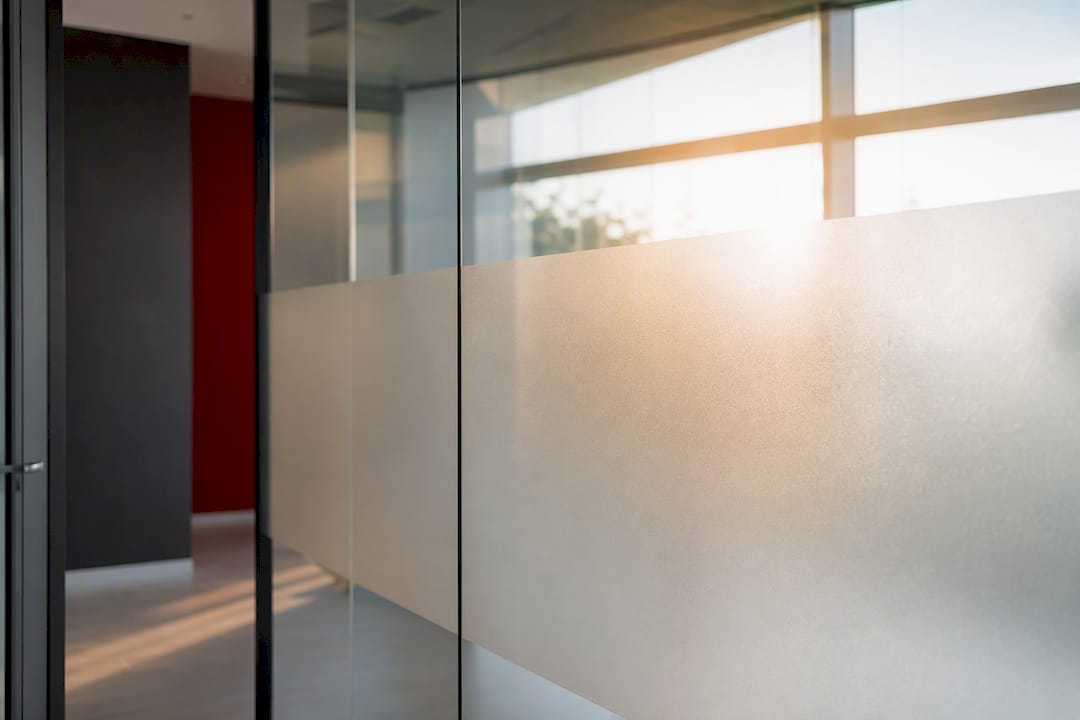
Start with the confidentiality requirement. An HR office or legal conference room needs full frosting or blackout film, no compromise. A general workstation partition usually only needs a privacy band at eye level, since the goal is blocking casual eye contact, not sealing the room visually.
Aesthetics come next. If the office brand identity matters in that space, a decorative or logo-etched film does more work than plain frost, and partial frosting in bands or lower panels often keeps an open-office feel while still branding the glass.
Light transmission is the variable people most often get wrong. Full blackout film kills natural light entirely, which is fine for a server room but miserable in a conference room where people sit for hours. Frosted film keeps transmission high while still blocking direct sightlines, which is why it dominates general office use over blackout options.
A simple way to decide: rank the room on confidentiality first, aesthetics second, and daylight third, then pick the lightest-transmission film that still satisfies the top priority. Going heavier than the confidentiality requirement demands just costs more and makes the room feel closed in for no reason.
What to Ask Before Hiring a Privacy Film Installer
Credentials matter more than price on this particular purchase, since a $2 per square foot difference in quote disappears fast if a bad install voids your warranty within a year.
Ask directly whether the installer is certified by the manufacturer, not just an authorized reseller. Certification usually means the installer has been trained on that specific film’s application requirements and that manufacturer warranty coverage stays intact. A vendor who dodges the question or can’t name which brands they’re certified for is a red flag worth walking away from.
Ask to see reference installations, ideally in a similar commercial setting, not just residential tint jobs. Office glass involves different considerations than home windows: larger panes, partition hardware, ADA-compliant signage requirements, and often coordination with building management or landlord approval.
Review count and rating alone don’t tell the full story. Look for reviews that specifically mention commercial or office work, not just car window tinting, since many installers split time across very different service lines. Ask how the company handles rework if bubbling or peeling shows up within the first year, and get that answer in writing before the job starts.
A legitimate installer will also walk your space in person before quoting rather than pricing off photos alone. Anyone willing to quote a full office job sight unseen is skipping a step that matters.
How Do You Get Samples Before Committing to a Project?
Ordering samples is the one step you should never skip, and reputable vendors make it easy. Most manufacturers and installers offer sample books or individual swatches at no cost, specifically so buyers can hold the actual material against their own glass under their own lighting conditions.
The process is usually straightforward: request samples through the vendor’s site or a site visit, receive swatches covering the film types relevant to your project (frosted, decorative, gradient, or blackout), then view them against your windows at different times of day. Morning light and late afternoon light change how a frosted film reads, and a swatch that looks perfect under showroom lighting can look different in your actual conference room.
For larger projects with multiple rooms or a mix of film types, ask whether the vendor can leave a small sample book on-site for a few days rather than a single swatch. That gives your team time to compare options across different rooms and lighting conditions before committing to a full order. It also surfaces any concerns about pattern visibility or opacity before production starts, which is far cheaper to catch at the sample stage than after installation.
The Real Decision Point Most Guides Skip
Most guides on this topic spend their word count comparing brand names side by side, as if the film itself is where projects succeed or fail. It isn’t. The film is a commodity relative to the install. A mediocre film applied by a skilled technician with clean substrate prep and proper edge sealing will outlast a premium film applied poorly.
Where the conventional advice falls short is treating opacity and pattern choice as the hard part of the decision. The harder part is procurement discipline: getting a written warranty that names both the material and the workmanship, confirming interior versus exterior ratings before ordering, and viewing samples in your actual space rather than trusting a catalog photo.
If you take one thing from this guide, prioritize the installer’s certification and warranty language over the film’s brand name. Get that right first, and the choice between frosted, gradient, or decorative film becomes a much simpler conversation about how your office actually uses each room.
— Jake
Ready to Move From Research to a Site Visit?
You’ve seen the film categories, the pricing shapes, and the questions worth asking any installer. Twtwindowfilm has been installing office privacy and solar film across Orange County and Los Angeles County since 2008, working with 3M and LLumar materials under a lifetime warranty on every commercial installation.
That local, direct-install model is the practical alternative to piecing together a DIY film order and hoping the edges hold. Twtwindowfilm’s team measures your glass on-site, brings sample swatches to view under your own office lighting, and quotes the job before any cutting starts, whether you need full frosting for a conference room, branded graphics for a lobby, or a combined solar and privacy solution for exterior glass. Request a free on-site estimate and get sample swatches sent to your office before you commit to a single square foot.
Sources
- 3M™ Privacy Film | 3M United States
- Office Window Frosting Sydney | Glass Partition Privacy | EverClear Window Tinting
- Frosted Office Window Film London | Enhance Privacy & Professional Aesthetics — London Window Films
- Window Frosting for Offices & Businesses: Benefits, Uses, and Design Ideas - Custom Signage NYC