
Facility Managers: Glass Manifestation Film That Passes Inspection
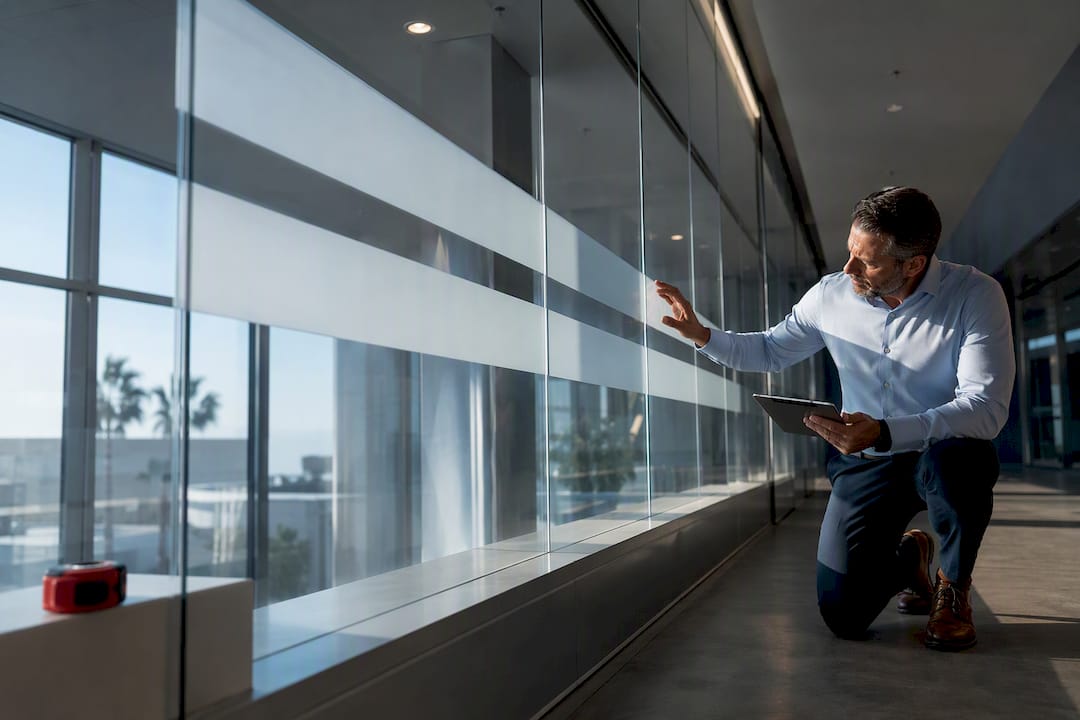
Use frosted or high-contrast glass manifestation film applied at the two standard height bands, and book a professional survey before you order anything. That combination gets you past inspection, cuts collision risk, and keeps your warranty intact. Skip the survey and you risk mismatched contrast, wrong placement, or a film that fails the first time someone questions your compliance paperwork. Measure the glazing, document every door and partition, then schedule installation with a crew that stands behind the work.
TL;DR:
- Proper survey and measurement are crucial to ensure manifestation film passes inspection and aligns with local codes, eliminating costly rework.
- Frosted or etched-effect film suits long-term compliance and branding needs, while reflective or printed graphics provide specific privacy or aesthetic functions.
- Professional installation with certified crews and documented specifications helps prevent common issues like bubbles, edge lift, or contrast mismatch.
- Film longevity depends on material quality, installation environment, and maintenance, with warranties typically covering issues like peeling or fading for over 10 years.
- Using a supplier who emphasizes site-specific surveys, clear communication, and reputable brands ensures compliance, durability, and consistent results across multiple sites.
Table of Contents
- What Is Glass Manifestation Film and Why Do Buildings Need It?
- Regulatory Placement, Sizing, and Contrast: A Practical Checklist
- Which Film Material Fits Your Building’s Design Goals?
- How Should Manifestation Film Be Installed and Placed?
- How Long Does Manifestation Film Last, and What Warranty Should You Expect?
- Why Choose a Certified Installer for Manifestation Work?
- What Compliance Standards Should You Verify Before Sign-Off?
- How Do You Compare Costs Across Manifestation Film Options?
- What Installation Mistakes Cause Manifestation Film to Fail?
- What Should You Ask a Manifestation Film Supplier Before You Buy?
- What Are the Warning Signs of a Low-Quality Manifestation Film?
- How Do You Evaluate a Manifestation Film Supplier?
- Editorial Take: Compliance Comes Before Design, Not After
- Get a Compliant Manifestation Film Survey Scheduled
- Sources
- FAQ
What Is Glass Manifestation Film and Why Do Buildings Need It?
Glass manifestation film is a pattern, decal, or frosted treatment applied to glass so people notice it’s there instead of walking into it. Large panes of glass, especially frameless doors and floor-to-ceiling partitions, are nearly invisible under the right lighting. Manifestation breaks up that transparency with a visible marker that the eye catches before the body does.
The safety case is straightforward: buildings with unmarked glass see more collision incidents, and that translates directly into liability exposure for owners and operators. Accessibility rules add another layer, since people with low vision depend on strong visual cues to detect glazing that sighted pedestrians might spot instinctively. Industry guidance tied to workplace safety regulations requires that large panes likely to be mistaken for open doorways get marked with durable materials.
You’ll typically need manifestation in these spots:
- Frameless glass doors and adjacent side screens
- Full-height internal partitions in offices and corridors
- Low-contrast glazing near stairwells or open-plan walkways
- Storefront glass at pedestrian eye level
- Internal glass in schools, government buildings, and other public facilities
Regulatory Placement, Sizing, and Contrast: A Practical Checklist
Inspectors look for specific measurements, not general good intentions. Getting the height bands and sizing right the first time saves you a costly second visit from your installer.
- Mark at two height bands. Guidance commonly calls for markings between 850 and 1,000 millimeters and again between 1,400 and 1,600 millimeters from finished floor level, giving both seated and standing sightlines a visual cue.
- Size strips and logos correctly. Prominent strips or logos should be of sufficient height for full visibility; smaller broken-line designs can be smaller if repeated frequently enough.
- Check contrast in every lighting condition. A frosted dot that reads clearly at noon can disappear against a dark lobby wall at dusk. Test your chosen film against the actual background, not a sample board.
- Confirm local code before sign-off. These height bands and sizing figures reflect common industry practice, but regional building codes vary. Verify requirements with your local authority before finalizing design.
- Document everything for your compliance file. Photograph placement, measurements, and film specification sheets. Inspectors and insurers both ask for this later.
Which Film Material Fits Your Building’s Design Goals?
Not every manifestation job calls for the same material. The right choice depends on how much privacy you need, whether you want branding built in, and how the space gets used day to day.
- Frosted or etched-effect film delivers consistent visibility around the clock and works whether the room is lit or dark, making it the most dependable option for straightforward compliance and long-term branding.
- Opaque privacy film blocks outside views entirely. Good for restrooms, conference rooms, or server closets, but wrong for any storefront or lobby where you still want a sightline.
- Reflective or one-way film only provides privacy during daylight hours. Once the interior gets brighter than the exterior after dark, the reflective effect reverses and passersby can see straight in.
- Printed and colored graphics can carry a logo or brand pattern while still meeting size and contrast rules, as long as the design elements hit the minimum height and spacing at both marked bands.
- Adhesive type matters too. Static-cling film is easy to remove and reposition but wears faster; permanent adhesive film holds up under commercial traffic and daily cleaning.
Pro Tip: If a client insists on 24-hour privacy without losing the view during the day, combine transparent reflective film with interior blinds rather than promising something no single film can deliver.
How Should Manifestation Film Be Installed and Placed?
Placement decisions made during survey determine whether the finished job passes inspection or gets flagged for rework.
- Survey the glass first. Measure every pane, map sightlines from both directions, note background contrast, and record door swing directions and hardware locations.
- Treat door edges deliberately. High-visibility strips belong at the leading edge of any glass door, and adjacent side screens need matching markings so the whole opening reads as one visual unit.
- Hire a professional for the fit. DIY static-cling products from retail shelves work for a single home window, but a commercial installer avoids trapped air bubbles, edge lift, and thermal stress that can crack tempered glass under heat load. Professional installation is also usually what keeps a manufacturer warranty valid.
- Decide interior versus exterior placement. Interior film is easier to clean and less exposed to weather, but exterior placement can hide seams better on heavily viewed storefronts. Weigh access for future cleaning against the visual result you want from the street.
How Long Does Manifestation Film Last, and What Warranty Should You Expect?
Commercial-grade manifestation film commonly holds up for 10 years or more, though heat exposure, direct sun, and heavy-traffic cleaning all shorten that window. A film installed on exterior glass exposed to strong sunlight ages faster than one on a shaded internal partition.
Keep it simple:
- Clean with non-abrasive products and a soft cloth. Skip razor blades and anything with a sharp edge near the film’s border.
- Inspect edges twice a year for lifting or delamination, especially near door handles and high-touch zones.
- Replace promptly once bubbling or discoloration starts. A failing film looks worse than no manifestation at all.
Warranty coverage separates professional installs from DIY kits. A reputable installer’s warranty typically covers peeling, fading, and defects tied to the installation itself, not just the material. A roll of film bought online and applied in-house usually carries only the manufacturer’s product warranty, with none of that installation-defect protection.
Why Choose a Certified Installer for Manifestation Work?
A locally owned window film company operating since 2008 serves commercial and residential properties throughout Southern California. That history matters when you’re trusting a contractor with glass that has to pass inspection the first time.
The company installs premium film from 3M and LLumar, backed by a lifetime warranty on installations, which covers the kind of long-term peeling and edge failure that DIY jobs rarely guard against. Beyond manifestation and privacy work, some window film providers also handle decorative frosted graphics, anti-graffiti film, and safety film for schools and government buildings, allowing multiple needs to be addressed in a single visit.
What Compliance Standards Should You Verify Before Sign-Off?
Manifestation compliance isn’t governed by a single universal code. It sits under a mix of workplace health and safety regulations, accessibility standards, and local building codes, and the exact wording differs depending on where your property sits and what kind of building it is.
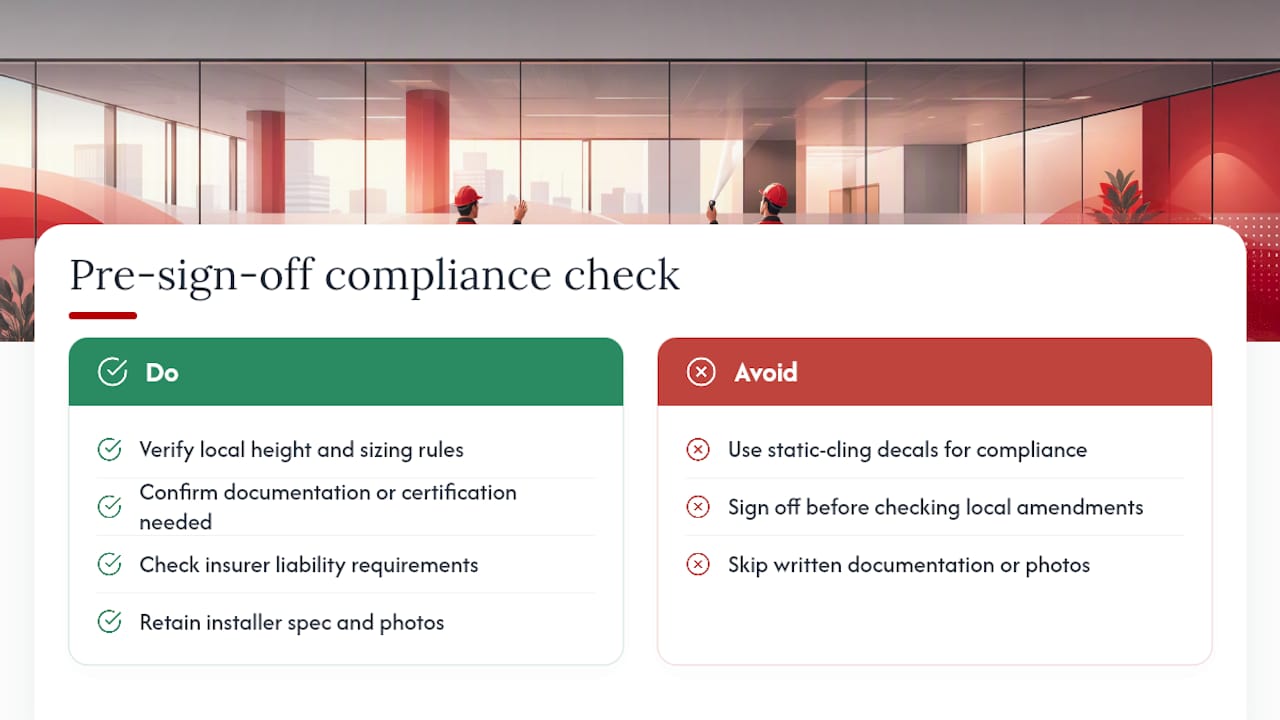
Start with the workplace safety angle. Regulatory language commonly requires that large panes likely to be mistaken for a doorway or open space be made apparent using durable, permanent materials, an obligation that shows up repeatedly in industry supplier guidance tied to workplace regulations. This durability requirement is why static-cling decals from a big-box store don’t satisfy commercial compliance the way a properly bonded film does.
Accessibility codes layer on top of that. They typically dictate the height bands and contrast levels your manifestation needs to hit so people with limited vision can detect glazing at a normal walking pace, which is where the 850 to 1,000 millimeter and 1,400 to 1,600 millimeter bands come from.
Before you sign off on any installation, confirm three things with your local building authority: the exact height and sizing rules that apply to your building type, whether your jurisdiction requires documentation or certification of the installed film, and whether your insurer has separate requirements tied to liability coverage. A film that satisfies a generic checklist but misses a local amendment still leaves you exposed. Ask your installer for a written specification sheet on the film used, along with photos of the finished placement, so you have a paper trail if a question comes up during a future inspection or insurance review.
How Do You Compare Costs Across Manifestation Film Options?
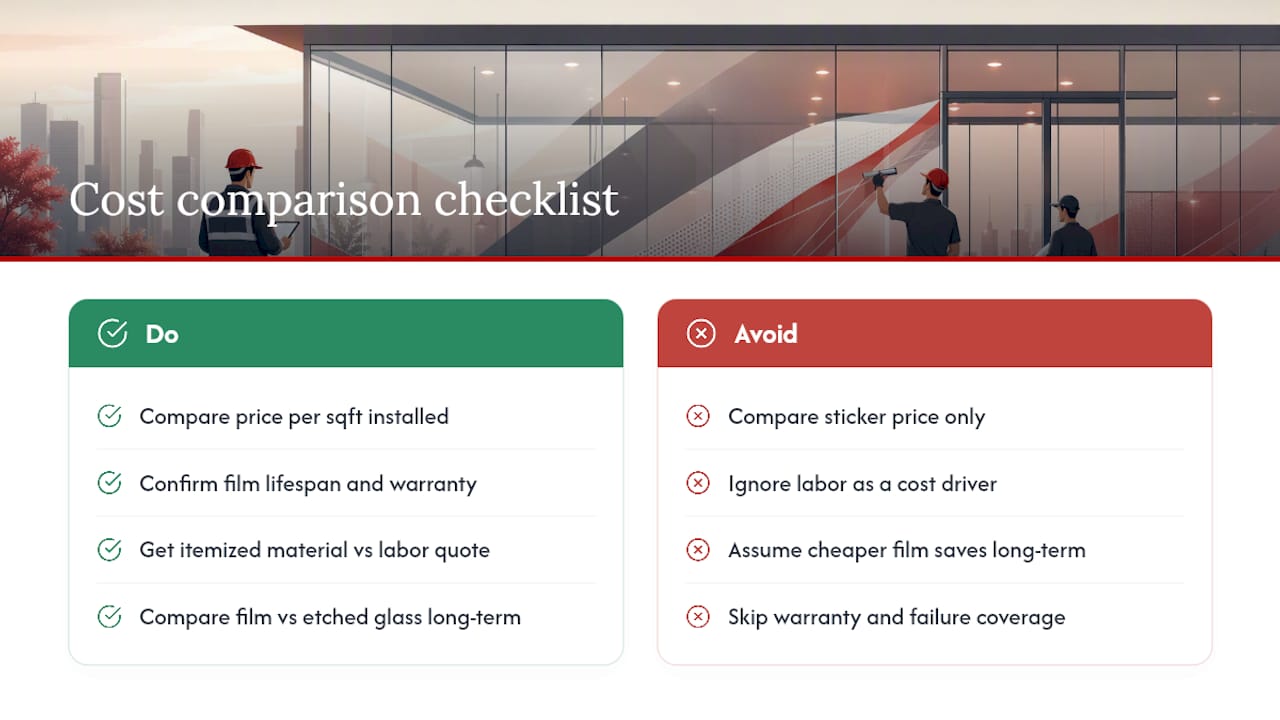
Cost comparisons in this category go wrong when buyers compare sticker price alone instead of price per square foot installed, film lifespan, and what’s covered if something fails.
Start with the material tier. Frosted and printed graphic films sit in the mid-range, opaque privacy films run similar territory, and fully custom printed branding with logos costs more because of design and production time. Reflective one-way film often prices close to frosted film but comes with the daytime-only privacy limitation, so a lower number on a quote doesn’t always mean better value for your use case.
Commercial-grade film is consistently framed by manufacturers as a lower-cost alternative to acid-etching or sandblasting glass, since etching physically alters the glass and film doesn’t. If a supplier quotes etched glass replacement against film, ask for the full comparison, including how each option performs if the design needs to change in five years. Etched glass is permanent; film is replaceable.
Labor is often the bigger cost driver than material. A straightforward strip application on a handful of doors runs quick, but full-height partition coverage with printed branding across a large glass facade takes longer and requires more precise alignment. Get itemized quotes that separate material cost from labor, so you can see where the money actually goes.
Finally, factor in what happens if the film underperforms. A cheaper film with no installation warranty that needs replacing in three years often costs more over a decade than a warrantied product installed once by a professional crew.
What Installation Mistakes Cause Manifestation Film to Fail?
Most manifestation failures trace back to a handful of repeatable mistakes, and nearly all of them show up during survey or application, not months later.
Skipping the pre-installation survey is the biggest one. Without accurate measurements and sightline mapping, installers end up guessing at height bands, and a guessed 900 millimeter mark can drift enough to fail an inspection. Trapped air bubbles and dust under the film come next, usually from applying film in a dirty environment or rushing the squeegee pass, and both defects are far more visible once the film is dry and impossible to fix without a full reapplication.
Mismatched contrast is a subtler problem. A film that looks perfectly visible against a white test board can nearly disappear against a dark wood door or a busy street-facing backdrop, so testing against the actual installation background matters more than trusting a sample chip.
Ignoring door swing and hardware clearance causes callbacks too. Manifestation strips placed too close to a door’s edge can catch on hinges or interfere with panic hardware, which is a safety issue on top of a cosmetic one. And thermal stress from applying film on glass that wasn’t rated for it, particularly on south or west-facing exterior glazing, can crack a pane that was fine before installation.
The fix for nearly all of these is the same: a proper measured survey, application in a controlled clean environment, and a crew that has handled commercial manifestation work before, not just residential tint jobs.
What Should You Ask a Manifestation Film Supplier Before You Buy?
A short list of direct questions separates a supplier who can deliver compliant work from one who’s just selling rolls of film.
Ask what brands of film they install and whether those brands carry a manufacturer warranty separate from the installer’s own coverage. Ask how they handle the survey process, specifically whether someone measures your glass on-site before quoting, or whether the quote is a rough estimate based on photos. Ask for the exact height bands and sizing they plan to use, and whether those numbers are based on your local code or a generic industry default.
Ask about lead time from signed quote to installed film, since printed or custom graphic work often takes longer than stock frosted patterns. Ask what happens if the finished installation doesn’t pass an inspector’s review, specifically whether rework is covered under the original quote or billed separately. And ask for references or examples of similar commercial jobs, ideally ones involving the same building type, whether that’s a school, storefront, or office partition.
A supplier who answers these questions clearly and specifically, without vague reassurances, is usually the one who has done this work enough times to know where it goes wrong.
What Are the Warning Signs of a Low-Quality Manifestation Film?
Poor manifestation film tends to announce itself early, and knowing the signs before installation saves you from a costly redo.
Watch for film that’s noticeably thin or flexes easily when handled. Commercial-grade film has enough body to lie flat without wrinkling, while cheap film tends to ripple or show air pockets almost immediately after application. Yellowing or fading within the first year is another red flag, often tied to low-grade adhesive or a film with no UV stabilizers, and it shows up fastest on south-facing glass.
Inconsistent opacity across a single roll is a quality problem too. If one section of frosted film looks noticeably different in density from another section of the same roll, that inconsistency will be obvious once it’s on the glass and lit from behind. Peeling edges within months of installation almost always point to either poor adhesive quality or a rushed application, and it’s the single most common warranty claim installers deal with.
Be cautious of any supplier who can’t tell you the film’s expected lifespan or won’t put a warranty in writing. Vague answers about durability usually mean the product hasn’t been tested for commercial use, or the supplier doesn’t stand behind their own installation work.
How Do You Evaluate a Manifestation Film Supplier?
Beyond the film itself, the supplier relationship determines how smoothly the whole project runs, from first quote to final inspection.
Lead time is often the deciding factor for facilities managers working against a compliance deadline. Ask directly how long it takes from approved design to scheduled installation, and whether that timeline changes for custom printed graphics versus stock frosted patterns. A supplier promising next-day installation on a fully custom branded design is either overstating their capacity or cutting corners somewhere.
Customization capability matters if you need logos, specific patterns, or brand colors worked into the manifestation design. Some installers only offer stock dot patterns and basic frosted strips, while others can produce fully printed, brand-matched graphics that still satisfy height and contrast requirements. If your building needs both compliance and a cohesive look across multiple entrances, confirm the supplier can deliver consistent design across every door and partition, not just a one-off sample.
Also weigh how the supplier handles multi-site work if you manage more than one property. A supplier who can schedule consistent installation crews across several locations, using the same film specification each time, saves you from mismatched results building to building.
Editorial Take: Compliance Comes Before Design, Not After
Most manifestation guidance treats safety and design as separate decisions made in sequence: pick your look, then figure out how to make it legal. That order gets buildings into trouble. The research on placement and sizing points the other way: the height bands, contrast rules, and durable-material requirements aren’t a constraint on design, they’re the design brief itself.
What’s overrated in this category is the idea that reflective one-way film solves privacy problems on its own. It doesn’t, and any supplier who sells it as a 24-hour solution is setting a client up for a complaint once the sun goes down. Frosted film without that gap is the more honest recommendation for most commercial spaces, even though reflective film photographs better in a sales brochure.
What facilities teams should prioritize first isn’t the prettiest pattern in a catalog. It’s the survey. Measured height bands, tested contrast against the real background, and documented door hardware clearances prevent nearly every callback this category generates. Design comes after that groundwork, not before it.
— Jake
Get a Compliant Manifestation Film Survey Scheduled
Choosing a professional window film installer who provides free on-site surveys, certified crews trained on leading brands, and a warranty covering installation defects rather than just the material helps ensure compliance and durability.
If your building needs manifestation on storefront glass, office partitions, or school entrances, start with the commercial services page to see the full range of privacy, security, and decorative film options. For spaces that also need branded graphics alongside compliance markings, the frosted graphics team can design manifestation patterns that double as visual branding. Reach out for your free estimate and get a measured survey on the calendar before your next inspection.
Sources
- Manifestation Markings for Glass | Window Safety Graphics
- Manifestation Film | Window Safety Film | Sun-X
- A Complete Guide to Privacy Window Film
- 3M™ Privacy Film, Matte, 2 mil, 60 in x 100 ft, 1 Roll/Case | 3M United States
FAQ
What Is Glass Manifestation?
Glass manifestation is a visible marking, pattern, or film applied to glass doors and large panes so people notice the glass instead of walking into it. It’s typically required at two height bands to catch different sightlines and is treated as a safety and accessibility feature, not just decoration.
Does Reflective Window Film Really Work for Privacy?
Reflective one-way film works for privacy only during daylight hours, when the exterior is brighter than the interior. Once that balance flips after dark, the reflective effect reverses and interiors become visible from outside, so it’s not a full-time privacy solution on its own.
How Much Does Glass Security or Manifestation Film Cost?
Cost depends on film type, square footage, and whether the design includes custom printing or branding, so Twtwindowfilm provides pricing through a free on-site estimate rather than a flat published rate. Facilities managers can request a quote through the commercial services page for an accurate figure based on their specific glazing.
Can You See Through Mirrored Window Film at Night?
Yes. Mirrored or reflective film loses its one-way effect once the room behind it is lit and the outside is dark, allowing people outside to see in clearly. Buildings that need round-the-clock privacy typically pair transparent reflective film with blinds or shades, or choose frosted film instead.
How Long Does Professionally Installed Manifestation Film Last?
Commercial-grade manifestation film commonly lasts 10 years or more, depending on sun exposure and cleaning habits. Professional installation with a lifetime warranty, like the coverage Twtwindowfilm provides, protects against peeling and installation defects that shorten that lifespan.