
Warranty Backed Safety Compliant Branded Window Film
Branded window film is printed or cut vinyl applied to glass to display logos, promotional graphics, or privacy patterns while still letting daylight through. Pick the type by three questions: do you need to see through it, is the campaign temporary or permanent, and does the glass require safety markings by code. Storefronts, offices, restaurants, and vehicles all use it differently, but the decision logic stays the same.
TL;DR:
- Perforated film is best for storefronts needing exterior branding with interior visibility, but it has a moderate lifespan and requires UV protection.
- Frosted and manifestation films are suitable for privacy and safety markings in interior spaces, with long-lasting durability and minimal fading.
- Printable films are ideal for short-term campaigns, offering full-color detail but fading faster under sun exposure, especially on exterior surfaces.
- Choosing high-quality brands like 3M or LLumar and professional installation ensures maximum lifespan and compliance with safety codes.
- Proper surface preparation, measurement, and adherence to local safety regulations are critical for a successful long-lasting installation.
Table of Contents
- What Types of Branded Window Film Are Available?
- Where Does Branded Window Film Deliver the Most Value?
- Which Materials and Brands Actually Hold Up?
- How Do You Prep Artwork and Install Branded Film Correctly?
- What Are the Safety Rules for Glass Manifestation?
- How Do You Choose a Vendor for Branded Window Film?
- Why Professional Installation Still Matters Most
- Ready to Brand Your Windows the Right Way?
- Sources
What Types of Branded Window Film Are Available?
Not every film does the same job, and picking the wrong one wastes money on both the material and the install. Here’s how the main categories break down.
Perforated or one-way vision film carries a printed design on the exterior side while the interior side stays semi-transparent, punched with thousands of tiny holes. Staff inside can still see the street; people outside see your logo or campaign artwork. Restaurants and banks lean on this heavily for storefront glass where staff need a view out but the business wants a billboard-sized ad space facing the sidewalk.
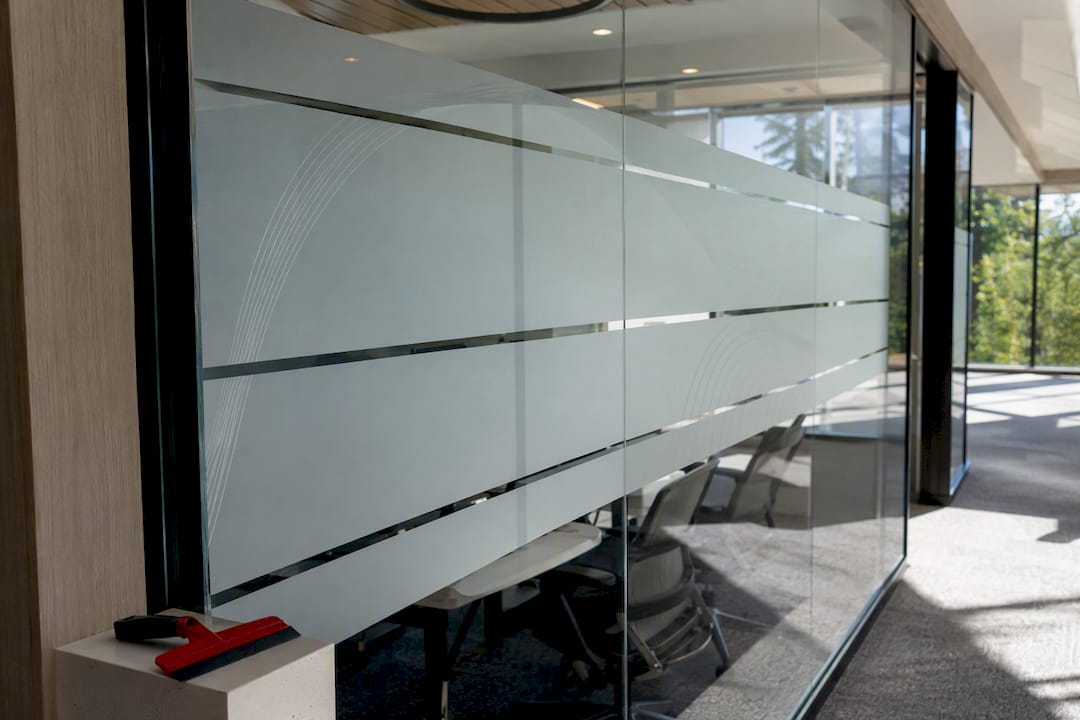
Frosted, decorative, or manifestation films etch a matte or patterned look into the glass without any printing at all. They’re the go-to for conference room walls, office partitions, and any glazing that needs a privacy layer plus a required safety marking (more on that below).
Printable opaque or translucent films run through wide-format printers, meaning full color, gradients, and photography are all fair game. These work best for seasonal promotions, product launches, or any campaign with a defined end date, since printable films come in removable-vinyl versions built for exactly that turnover.
Solar and privacy films combine heat and glare control with a branding layer, either as a tinted base with a printed overlay or a frosted pattern that doubles as sun control.
Security and anti-graffiti films add a thick polyester layer that resists shattering and vandalism, letting a business protect both the glass and whatever graphics sit on top of it.
- Perforated/one-way: exterior branding, interior visibility retained
- Frosted/manifestation: privacy plus code-required safety marks
- Printable opaque/translucent: full-color, short or long-term campaigns
- Solar/privacy: heat reduction layered with branding
- Security/anti-graffiti: shatter resistance and vandalism protection
Where Does Branded Window Film Deliver the Most Value?
The same film category shows up in wildly different settings, and the right choice usually comes down to how much see-through visibility a space actually needs.
- Retail storefronts use perforated film for seasonal campaigns and printable vinyl for shorter promos, balancing exterior visibility against interior daylight.
- Offices and interior partitions rely on frosted or etched patterns for privacy, wayfinding, and code-compliant manifestations on glass doors and walls.
- Restaurants and hospitality spaces mix decorative privacy patterns with rotating seasonal graphics on street-facing windows.
- Homeowners often want privacy film that blocks sightlines without blacking out a room, especially on street-facing bathroom or bedroom windows.
- Fleet vehicles turn branded film into a moving billboard, using cut vinyl or printed wraps on windows and panels for constant visibility.
Interior glass doors present their own version of this trade off: a fully transparent door offers zero privacy, while a fully frosted one can feel closed off. The balance between privacy and openness on glass doors applies just as directly to office partitions as it does to interior architecture generally.
Which Materials and Brands Actually Hold Up?
Film construction varies more than most buyers expect, and the difference shows up years later, not on install day. Perforated vinyl is built for exterior application and UV exposure. Optically clear printable film is engineered for color accuracy and print resolution. Frosted polyester skips printing altogether and relies on texture and light diffusion instead.
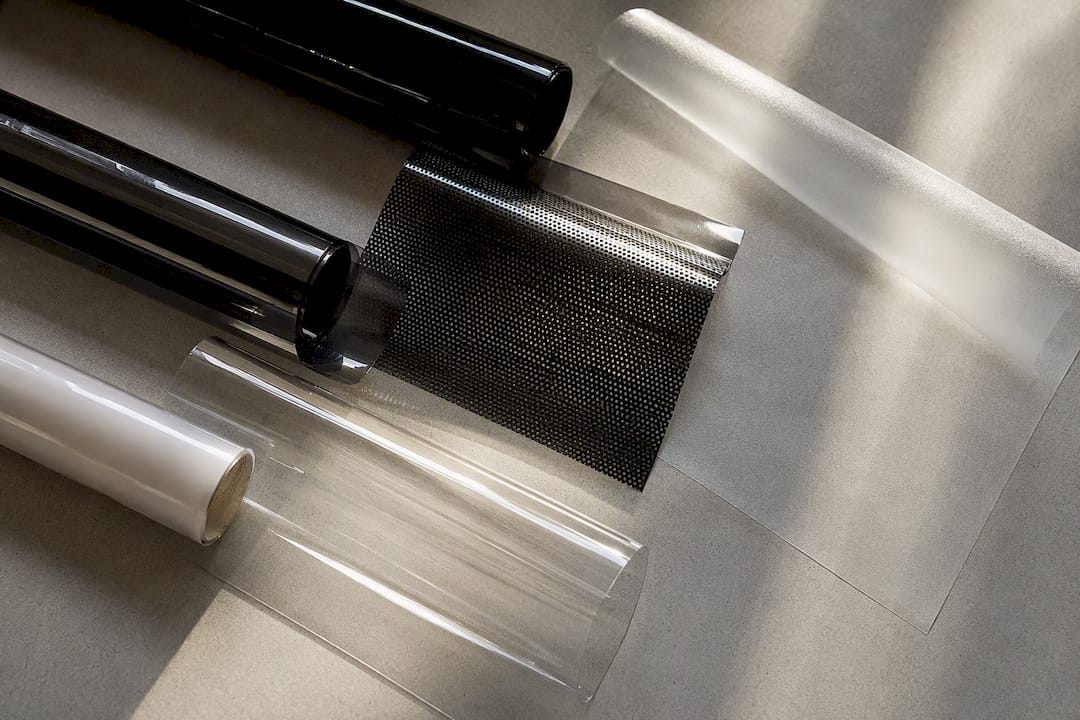
Brand matters here more than in most building materials categories. 3M’s graphics and signage line spans perforated, clear printable, and frosted constructions, each rated for different lifespans and application environments. LLumar runs a comparable range with its own adhesive systems and warranty backing. The adhesive technology is what separates a film that peels at the corners in year two from one that stays flat for a decade.
Pro Tip: Ask any installer for the manufacturer’s rated lifespan by film type, not a blanket number. A frosted privacy film and a printed exterior graphic age at completely different rates under the same sun exposure.
Lifespan expectations run roughly like this:
- Frosted/manifestation film: long-term, minimal fading since there’s no ink to degrade
- Printable exterior graphics: shorter lifespan under direct sun and weather exposure
- Perforated one-way film: moderate lifespan, print side faces the elements
- Security/anti-graffiti film: rated for structural durability more than visual longevity
Professional installation directly affects how long any of these hold up. A film applied without proper surface prep, or squeegeed with air bubbles trapped underneath, will lift and discolor faster regardless of what the manufacturer’s lifespan chart says. That’s a big part of why installation warranties exist separately from material warranties.
How Do You Prep Artwork and Install Branded Film Correctly?
Getting from concept to finished glass involves more technical steps than most business owners expect on their first project.
- Set up artwork correctly. Files need to be built in CMYK at a print-ready resolution, with panel layout and bleed marked for any multi-pane storefront window.
- Choose your perforation percentage. Higher perforation means more holes, which means better interior visibility but a less dense, slightly softer exterior image. Lower perforation flips that trade-off, since 3M’s own testing on perforated graphics confirms the visibility-versus-image-density relationship holds across their perforated product lines.
- Measure on-site before production. Glass panels are rarely perfectly uniform, and a measurement taken from blueprints instead of the actual window invites a bad fit.
- Prep the surface. Glass gets cleaned and sometimes treated before application; skipping this step is the single most common cause of bubbling.
- Install and let it cure. Most films need a curing window before they’re considered fully set, and this is where DIY jobs most often go wrong.
Pro Tip: If your storefront window sits more than 15 feet from the sidewalk, ask your installer whether a lower perforation percentage will actually read better at that viewing distance. Denser prints hold up visually from farther away.
Lead time depends on print complexity and panel count, and scaffolding or lift access on tall storefronts adds both cost and schedule time. Maintenance is simple, gentle cleaning with a non-abrasive solution, but security and anti-graffiti films need less babysitting since they’re built to shrug off scratches and tagging attempts.
What Are the Safety Rules for Glass Manifestation?
Large clear glazed surfaces need visible markings so people don’t walk into them, and this isn’t optional in most jurisdictions once glass crosses a certain size threshold. In the UK, guidance under Approved Document K typically calls for two marking bands, one roughly between 850mm and 1600mm from floor level, specifically to catch both standing adults and children at eye level. Requirements vary by jurisdiction, so check your local building code before finalizing a design rather than assuming one standard applies everywhere.
The smart move is turning that legal requirement into a design asset instead of treating it as a compliance tax. Manifestation markings can be printed with logos, dot patterns, or brand colors instead of generic frosted stripes, and suppliers regularly print bespoke manifestation designs that satisfy code while reinforcing brand identity at the same time.
- Measure your glazing height and panel width before designing markings
- Check local code for exact height bands and required contrast
- Keep spacing and repeat pattern consistent across the full panel
- Fold your logo or brand colors into the required marks rather than treating them as separate
How Do You Choose a Vendor for Branded Window Film?
The film itself only matters as much as the install behind it, so vetting the installer deserves at least as much attention as picking the material.
- Confirm warranty coverage. Ask whether the warranty covers the film, the installation, or both, and for how long.
- Check brand partnerships. Installers working directly with 3M or LLumar typically get better material access and manufacturer-backed support.
- Review a real portfolio. Ask for photos of completed jobs similar to your building type, not just stock manufacturer images.
- Get an on-site measure. Any installer quoting sight unseen is guessing, and that guess becomes your problem later.
- Request sample swatches. Color and opacity look different on a sample chip than on a monitor.
- Ask about removal policy. Know upfront what happens, and what it costs, when the film comes down.
Cost drivers worth asking about directly include film type, print complexity, panel count, and access difficulty. A single-story storefront with four flat panels costs far less to install than a multi-story facade requiring lift rental.
Why Professional Installation Still Matters Most
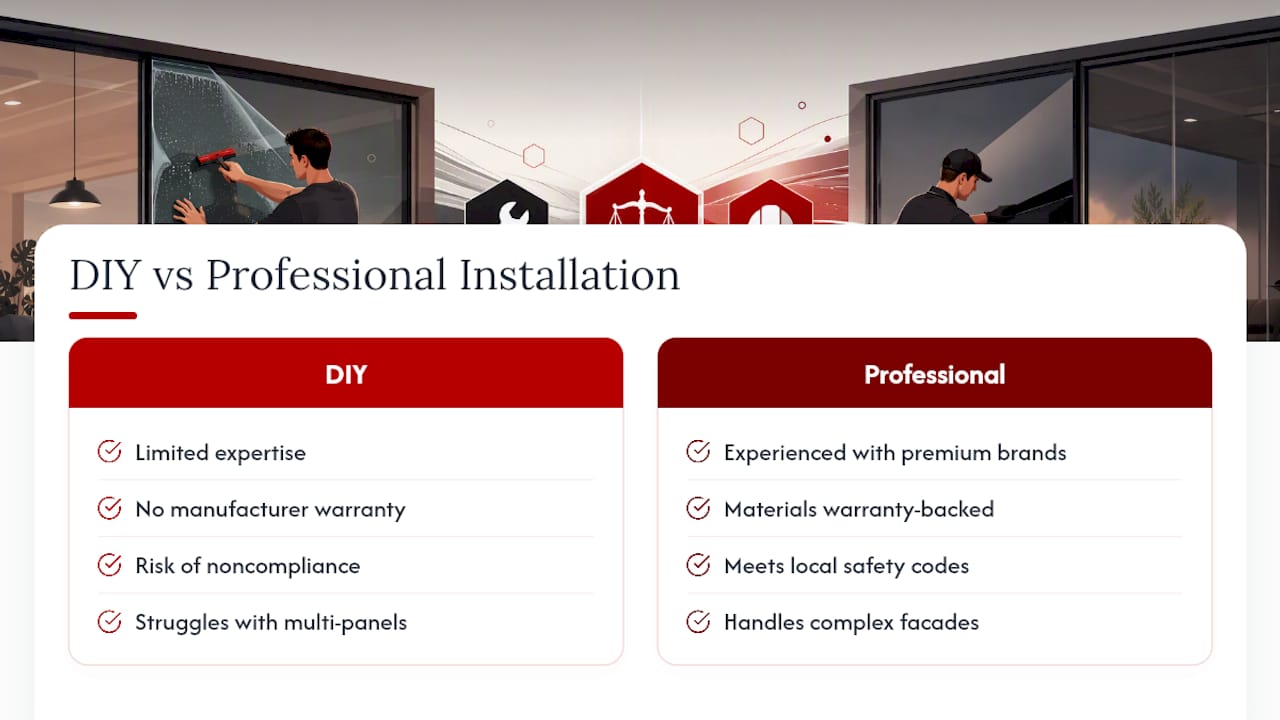
Anyone can buy a roll of film online. Getting it to lay flat, stay color true for years, and meet a local safety code is a different problem entirely, and it’s the reason DIY branded film projects so often end up redone within a year.
A professional window film installer in Southern California has experience working with premium brands like 3M and LLumar, using materials backed by manufacturer warranties. Complex facades, multi-panel storefronts, and any project touching code-mandated manifestation markings are exactly where professional installation pays for itself. A rushed DIY job on a compliance-driven install is a liability waiting to surface at the next inspection.
— Jake
Ready to Brand Your Windows the Right Way?
Some professional installers offer a lifetime warranty on the work itself, not just the material, which is a meaningfully different guarantee than most DIY suppliers offer. Whether you need storefront graphics for a retail campaign, frosted manifestations for office privacy, or security film that protects both your glass and your branding investment, the approach is the same: measure on-site, source through 3M and LLumar, and install it once, correctly.
A free on-site estimate covers your exact glazing, gives you real sample swatches to hold up against your brand colors, and lays out a production and install timeline before you commit to anything. If you’re running a storefront campaign, start with the retail storefront window film page to see what’s possible for your space, or head to the full services overview to book your on-site estimate today.
Sources
- Windows & glass applications - Graphics & Signage | 3M United States
- Manifestation Film | Window Safety Film | Sun-X