

3M Window Film Types: Series That Reject Up to 97% IR Heat for SoCal
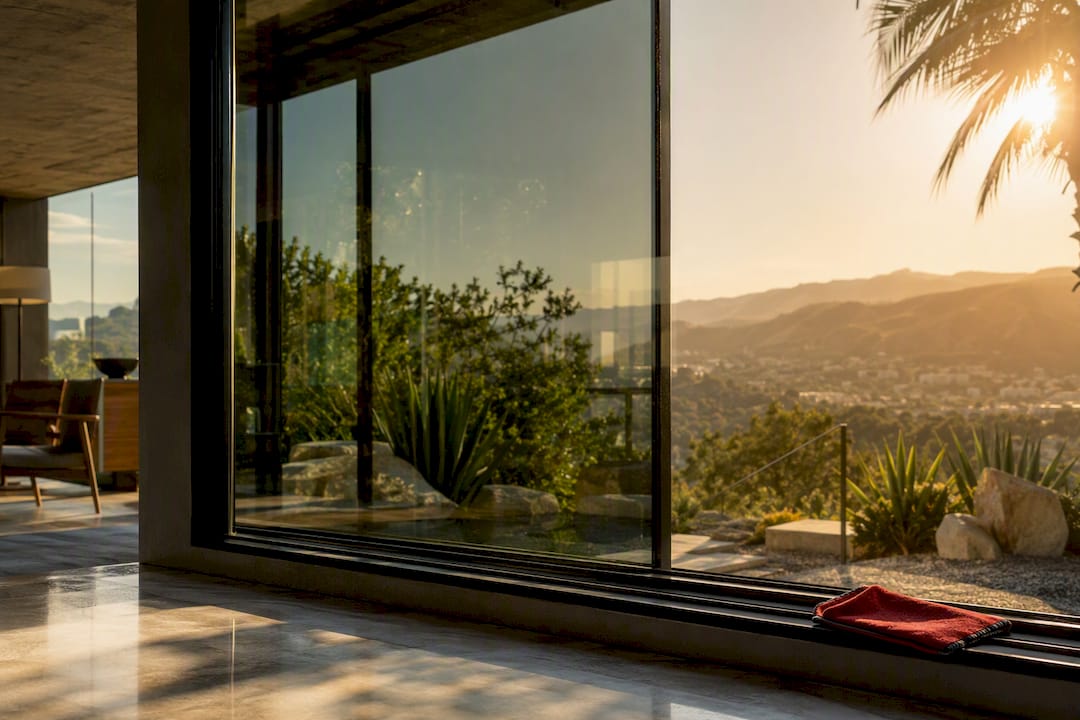
3M splits its window films into four working families: sun and heat control, safety and security, decorative and privacy, and automotive. For heat control, Prestige leads the lineup with spectrally selective technology. Night Vision suits homes and offices that want low glare after dark, Scotchshield handles security and impact resistance, and Crystalline or Ceramic IR covers vehicles. The choice depends on whether you’re mainly addressing heat, glare, break-ins, or a combination of these concerns.
TL;DR:
- Spectrally selective Prestige film offers the highest infrared heat rejection, especially at steeper sun angles and during peak afternoon hours.
- Metallized films are more prone to signal interference and faster corrosion, making ceramic or non-metal optical builds a better choice in coastal or salt air environments.
- Security films focus on impact resistance and shard containment, not heat rejection, often requiring thicker layers and specific installation standards for effectiveness.
- Automotive films like Crystalline and Ceramic IR are tailored for vehicle glass, with Crystalline providing strong heat rejection at lighter tints, and Ceramic IR avoiding signal issues.
- Proper installation by authorized installers significantly influences film longevity and performance, with warranties typically covering defects but excluding improper cleaning or glass damage.
Table of Contents
- What Are the Main 3M Window Film Types?
- Which Prestige, Night Vision, or Traditional Film Fits Best?
- What Makes Safety and Security Film Different?
- When Should You Choose Decorative or Privacy Film?
- Which Automotive Series Should You Choose: Crystalline, Ceramic IR, or Color Stable?
- How Do You Choose the Right Film for Your Project?
- What Should You Expect From Installation and Warranty Coverage?
- What TWT SoCal Sees in the Field
- How Long Does Each Film Series Actually Last?
- Do These Films Actually Cut Energy Use and Environmental Impact?
- Is 3M Window Film Worth the Premium?
- Ready to Choose the Right Film for Your Property?
- Where to Check Exact Specs Before You Buy
- Sources
- FAQ
What Are the Main 3M Window Film Types?
3M groups its films into three primary categories: Light, Sun & Heat Control Films, Safety & Security Films, and a set of specialized options including privacy and All Season insulation films.
Automotive films get treated as a distinct fourth category in practice, since cars face different heat loads, glass curvature, and legal tint limits than a storefront or a living room window.
The technology inside each film matters more than the marketing name on the box. Three build types dominate:
- Non-metalized multi-layer optical film stacks hundreds of microscopic layers to bend and filter specific wavelengths of light, rejecting infrared heat without a metal coating.
- Metallized film uses a thin metal layer for heat rejection and a mirrored look, but it can interfere with cell signals and corrode faster in coastal air.
- Ceramic film relies on non-conductive ceramic particles instead of metal, giving similar heat rejection without the signal or corrosion issues.
That distinction explains why a beach-house client in a cell-dead zone gets steered away from metallized options, and why 3M’s multi-layer optical builds hold up better on glass facing salt air. The layer count also drives how a film performs as the sun angle steepens through the afternoon, which is why identical-looking films can post very different heat numbers at 2 p.m. versus 5 p.m.
Which Prestige, Night Vision, or Traditional Film Fits Best?
Sun-control film is where most homeowners and facility managers spend their research time, because the series differ more than they look on a swatch card.
Prestige is the flagship. It uses a non-metalized, spectrally selective build that rejects up to 97% of infrared heat and blocks up to 99.9% of UV rays, while still letting in enough visible light that rooms don’t feel dim. That combination makes it the pick for bright offices, showrooms, and living rooms where occupants want the heat gone without losing the view.
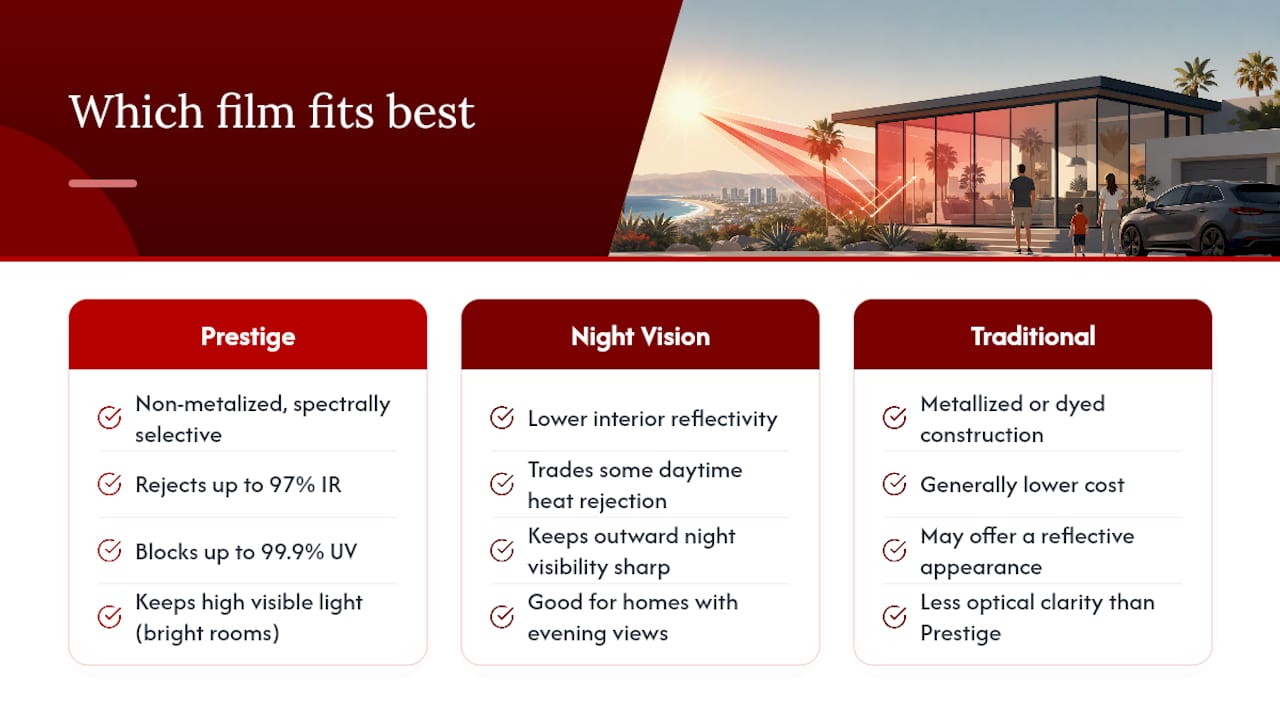
Night Vision trades some daytime heat rejection for lower interior reflectivity, so outward visibility at night stays sharp instead of turning the glass into a mirror. It fits homes with nice evening views and offices that run late.
Traditional, Neutral, and All Season films use more conventional metallized or dyed constructions. They generally cost less than Prestige and may be suitable for budget-conscious projects or spaces seeking a particular reflective appearance rather than highest clarity.
Reading the spec sheet: 3M’s own Prestige datasheets show model-by-model differences. The PR70 variant runs around 69% visible light transmission with its own TSER and infrared rejection figures, while darker PR models trade some VLT for higher heat rejection. VLT (visible light transmitted) tells you how bright the room stays; TSER (total solar energy rejected) tells you the overall heat cut; IR rejection isolates just the infrared band, which is the part you actually feel as heat on your skin.
One detail installers watch closely: Prestige’s non-metalized build increases the total solar energy it rejects as the sun angle gets steeper, meaning it performs best exactly when you need it most, during the hottest stretch of the afternoon.
What Makes Safety and Security Film Different?
Security film isn’t a thicker version of sun-control film. It’s a different product built for a different failure mode: keeping glass in one piece instead of keeping heat out.
These films use thicker polyester layers paired with more aggressive adhesive systems so that when the glass breaks, the shards stay bonded to the film instead of scattering. That buys time against forced entry, slows down smash-and-grab theft, and reduces flying-glass injuries during storms or blasts.
Common applications include:
- Retail storefronts targeted by break-ins or vandalism
- Schools and government buildings upgrading for occupant safety
- Coastal properties retrofitting against hurricane-driven debris
- Ground-floor offices and lobbies with high foot traffic exposure
Before choosing a security film, ask the installer for its glass-holding performance rating, ensure compatibility with your window frames and glazing, and verify whether it is rated for forced-entry delay, impact resistance, or both, as these represent distinct testing standards and one rating does not imply the other.
When Should You Choose Decorative or Privacy Film?
Decorative and privacy films address visibility and privacy needs more than heat or security, though they are often used alongside other goals. Frosted and sandblasted-style films mimic etched glass affordably and are popular for:
- Conference rooms and private offices requiring privacy without eliminating windows
- Commercial restrooms and shower glass
- Storefront branding via logos or patterns on windows
- Interior glass partitions in open-plan offices
Scale matters here in a way it doesn’t for sun-control film. A single frosted privacy band across a conference room door is a quick job. A full custom graphic across a 20-foot storefront window needs precise seaming and pattern alignment, so ask about the installer’s experience with large-format decorative work specifically, not just window tinting in general. For homes weighing decorative film against other privacy options, it’s worth comparing against alternatives like interior glass doors with built-in privacy features before settling on film.
Which Automotive Series Should You Choose: Crystalline, Ceramic IR, or Color Stable?
Car glass faces steeper sun angles, tighter legal limits, and more visible color-shift complaints than architectural glass, so 3M built a separate lineup for it.
Crystalline uses the same multi-layer optical approach as Prestige, adapted for automotive glass. It delivers strong heat rejection at a lighter tint shade, which appeals to drivers who want the cabin cooler without going dark enough to draw attention from law enforcement.
Ceramic IR films use ceramic particles instead of metal to block infrared heat, which means no interference with GPS, radio, or toll-tag signals, a real issue with older metallized automotive tints.
Obsidian and Color Stable lines focus more on appearance and long-term color consistency than maximum heat rejection, trading a bit of performance for a look that won’t purple or fade over the years.
Every one of those choices runs into the same wall: local tint law. VLT limits vary by state and even by window position on the vehicle, so confirm your local legal minimum before picking a darkness level, not after the film is already on the glass.
How Do You Choose the Right Film for Your Project?
Start with the problem you’re actually trying to solve, then match it to a film family.
- Name your primary goal. Comfort and energy costs point to sun-control film; UV and fading protection points to films like 3M Envision; break-in or storm risk points to security film; visual privacy points to decorative film.
- Request the actual numbers, not marketing language. Ask for VLT (brightness retained), TSER (total heat rejected), and UV block percentage for the specific model, not the product family.
- Ask the installer about your glass, not just the film. Single-pane versus double-pane glass, tempered versus laminated, and existing low-e coatings all change expected performance and can affect warranty eligibility.
Pro Tip: Bring a photo of your window frame and glass edge to the estimate. A lot of warranty disputes trace back to edge sealing on glass types the installer never actually inspected before quoting.
What Should You Expect From Installation and Warranty Coverage?
Film performance on paper and film performance on your actual window are two different things, and the gap is almost always installation quality.
- 3M runs a dealer training and authorization program, and several product warranties only apply in full when an authorized installer does the work.
- Residential jobs commonly carry lifetime warranty coverage; commercial installations more often run on multi-year terms tied to the building type and film series.
- Warranty exclusions typically involve improper cleaning, existing glass defects, or unauthorized removal attempts.
- Basic maintenance is simple: avoid ammonia-based cleaners and abrasive pads, and give new film the full cure time before washing.
What TWT SoCal Sees in the Field
Since 2008, Twtwindowfilm has installed 3M and LLumar films for homeowners, retailers, facility managers, and school administrators across Orange County and Los Angeles County, backed by a lifetime warranty on installations. Field visits always start the same way: verify glass type, measure heat and glare at the actual problem hours, and check edge and frame conditions before any film gets cut.
How Long Does Each Film Series Actually Last?
Longevity depends less on the series name and more on the build technology underneath it, though there are real differences worth knowing before you commit.
Non-metalized multi-layer optical films like Prestige tend to hold their color and clarity longest, because there’s no metal layer to oxidize or delaminate over time. Metallized Traditional-line films are more prone to a slight color shift, often a purple or brown tint, as the metal ages, especially on south-facing or west-facing glass that gets the most UV exposure. Ceramic automotive films sit in between: no metal to corrode, but the ceramic particle density can affect how evenly a film ages if the initial application wasn’t done cleanly.
Security films face a different aging pattern. The adhesive system that holds shattered glass together is engineered to stay flexible for years, but repeated impact events, even ones that don’t fully break the glass, can degrade that bond faster than normal sun exposure would. Decorative and privacy films generally hold up well since they’re not fighting heat or UV in the same way, though frosted finishes on high-touch surfaces like restroom doors show wear from repeated contact before they show any sun damage.
Maintenance across every series follows the same basic rules: skip ammonia cleaners, use a soft cloth or squeegee instead of anything abrasive, and don’t scrape at edges even if they look like they’re lifting. Most premature failures trace back to cleaning products or a rushed install, not the film itself.
Do These Films Actually Cut Energy Use and Environmental Impact?
Heat rejection isn’t just a comfort feature. It’s a direct load reduction on air conditioning, and that shows up on utility bills and, over enough buildings, on regional energy demand.
Sun-control films like Prestige reduce the solar heat gain coming through glass, which means HVAC systems run less during peak afternoon hours to hit the same indoor temperature. Buildings with large west-facing glass exposure, common in Southern California retail and office construction, see the biggest swings, since that’s exactly the window orientation catching the steepest, hottest afternoon sun. UV-blocking performance adds a second environmental benefit that gets overlooked: less UV exposure means less fading and material degradation on flooring, furniture, and merchandise, which extends the useful life of everything inside the building and cuts down on replacement waste.
Automotive films contribute a smaller but real effect. Reduced cabin heat load means less reliance on air conditioning at idle and during short trips, which matters more in stop-and-go traffic than on the highway. Security and decorative films don’t carry the same energy story, since their job is structural or visual rather than thermal, but installing any film family generally extends the useful life of the glass and window system by protecting it from sun-driven wear, which delays the environmental cost of full window replacement.
Is 3M Window Film Worth the Premium?
Pay for 3M when spectral selectivity actually matters to your situation: a bright office that can’t afford to feel like a cave, a storefront where signal interference from metallized film would break customer Wi-Fi, or a project where a multi-year commercial warranty needs to hold up under scrutiny. The dealer network and training program back that warranty with real accountability.
Lower-cost films can make sense on secondary buildings, rental units heading for renovation, or budget-constrained jobs where basic glare reduction is the only goal. For anything client-facing or long-term, the spectral-selectivity gap between Prestige-tier film and generic dyed film is large enough to notice within the first summer.
— Jake
Ready to Choose the Right Film for Your Property?
Picking between Prestige, Ceramic IR, and Scotchshield on a spec sheet only gets you so far. What actually determines the outcome is whether the installer measured your glass correctly and matched the film to your building’s real heat and light problem. A local window film installer has been solving that exact match-up for homeowners, retailers, and facility managers across Southern California since 2008, often backed by a lifetime warranty and partnerships with premium film brands.
If you’re weighing sun control for a home, start with the residential solar and privacy film page. Facility managers looking at storefront glare or office privacy can check the commercial solar and privacy film options, and school or government projects needing impact-resistant glass should look at the government building film services. Request a free on-site estimate through the full services page and get a specific recommendation for your glass, your climate exposure, and your budget.
Where to Check Exact Specs Before You Buy
For model-level numbers, go straight to the manufacturer. The 3M window film product hub lists every product family with category breakdowns. The Prestige series page covers performance claims and UV blocking, and the Prestige spec PDF has the model-by-model VLT, TSER, and IR rejection tables installers reference during quoting. Always confirm exact figures for your specific model before finalizing a purchase decision.
Sources
FAQ
What Are the Different Types of 3M Window Film?
3M’s core categories are Light, Sun & Heat Control Films, Safety & Security Films, and specialized privacy and insulation options, with automotive films forming a distinct fourth group built for vehicle glass and legal tint limits.
What Are the Different Types of Window Film in General?
Beyond 3M specifically, window films generally fall into dyed, metallized, ceramic, and multi-layer optical builds, each using a different method to block heat, reduce glare, or add privacy and security.
Is 3M Crystalline Better Than 3M Ceramic IR Tint?
Crystalline uses a multi-layer optical build that pushes heat rejection higher at a lighter tint shade, while Ceramic IR uses ceramic particles for solid heat rejection without any metal or signal interference; the better choice depends on whether you’re prioritizing maximum heat rejection or a lighter, more discreet look.
Which 3M Car Window Tint Is the Best?
There’s no single best option across every driver. Crystalline suits drivers wanting strong heat rejection at a legal, lighter shade, while Ceramic IR fits anyone concerned about signal interference with GPS or toll devices.
Is 3M Window Film Good for Long-Term Home or Business Use?
3M’s non-metalized films hold color and clarity well over time since there’s no metal layer to corrode, and coverage through an authorized dealer like Twtwindowfilm typically includes a lifetime warranty on residential installations.